
When do hedgehogs hibernate UK: signs, dates and jobs to delay
Most hedgehogs in the UK are still awake through October. Here is what actually starts hibernation, what it looks like in a garden, and which autumn jobs are worth holding back until the nests are empty.
We earn commission from qualifying Amazon purchases. It costs you nothing and does not affect what we recommend.
Quick answer
When do hedgehogs hibernate in the UK? Usually November or December, sometimes as late as January, and most are out again between mid-March and early April. October is early for it. The calendar only frames the answer: what settles it is your own garden, where the food stops going and the droppings stop appearing.
If you find a hedgehog
The British Hedgehog Preservation Society (BHPS) gives advice for each of these four situations.
What to do, by situation
- Out in daylight in autumn or winter, not in a nest, rushing about or curled up asleep. It needs rescuing however lively it looks. Box it and ring BHPS on 01584 890 801, as set out in the next situation. BHPS says a hedgehog out in the day can be days away from death, and may seem fine for a day before collapsing.
- Lethargic, lying in the open, wobbly, injured, trapped, or with flies around it, at any time of year. Lift it with gardening gloves or a folded towel into a high-sided box with an old towel to hide under, and bring it indoors. Add a hot water bottle filled with warm, not hot, water and wrapped in a towel, with room to move off it, and change the water before it cools: BHPS says a bottle allowed to go cold will chill the hedgehog and do more harm than good. Keep the box somewhere quiet, offer meaty cat or dog food and fresh water, then ring BHPS on 01584 890 801. If an answerphone picks up, press option 1 for the emergency numbers. If it is in obvious pain and needs urgent help, take it to a local vet immediately.
- Cold and curled up anywhere other than a well-made nest. Rescue it immediately, by the same box and phone steps. Hedgehogs do not hibernate in the open, so an animal with no nest dome around it is not safely hibernating.
- Curled up inside a well-made nest you have opened by accident. Leave it alone. Replace the nesting material and let it come round in its own time. BHPS says it will probably move to a new site itself. A bonfire pile you are about to light is the exception: box it with its nest, as set out in Building a bonfire.
In autumn and winter BHPS treats daylight activity as a reason to act whatever the animal is doing. The one exception belongs to summer: Hedgehog Street advises that a hedgehog moving with purpose and collecting grass or leaves is likely a mother gathering nesting material, and is best left.
If you are feeding one, learn the warning signs BHPS lists: it goes off its food, it wobbles or staggers, it starts coming out in the day, or it leaves green slimy droppings, especially with blood in them. Any of those needs help as soon as possible.
What your garden is telling you
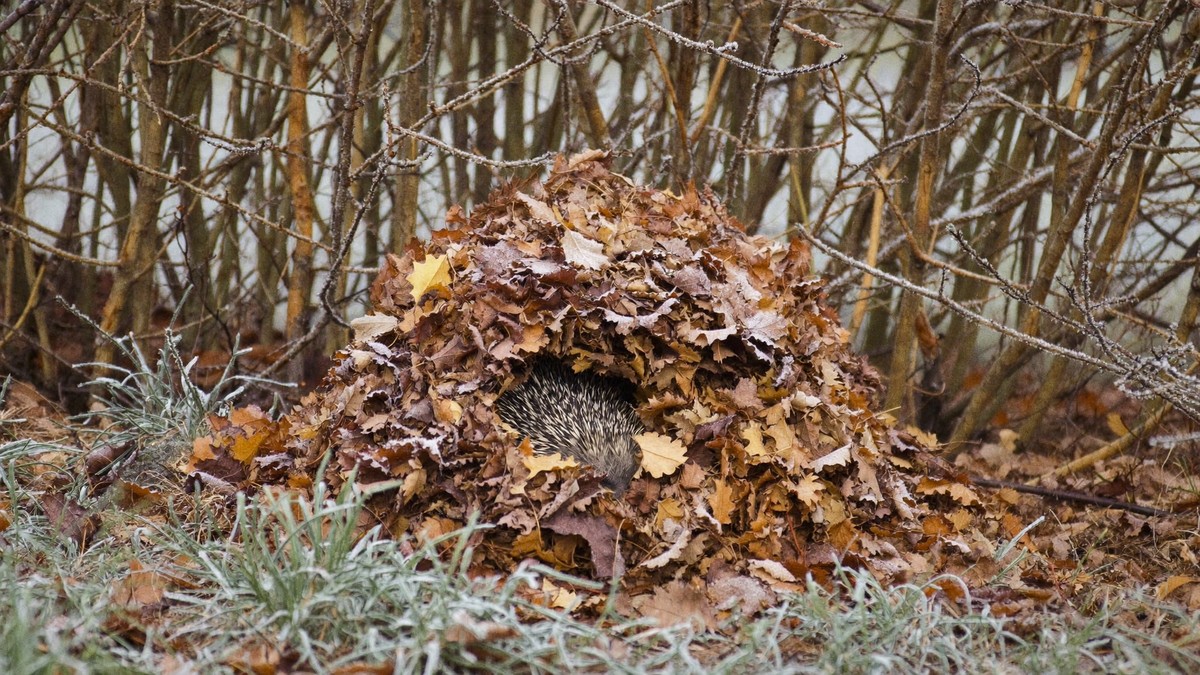
Hibernation is not a long sleep. BHPS describes a metabolism almost at a standstill, heart rate falling from roughly 190 beats a minute to about 20, which is why the animal cannot get out of the way of a fork. The nest, or hibernaculum, is recognisable once you know the shape: a compact dome of dry leaves and grass, 30 to 60cm across, with walls up to 10cm thick, built under hedges and tree roots, in brushwood piles, inside compost heaps or beneath timber sheds. The hedgehog vanishes into the depths of it and is completely hidden, so one lying out in the open is not hibernating.
The most useful signal is a feeding station. Hedgehog Street treats food going untouched, or less of it going, as the cue to taper off, and droppings stop at the same time. The catch is that cold or wet nights suppress feeding without hibernation having started, so the sustained pattern counts, not three quiet nights. We would treat a fortnight of untouched food as the signal rather than a date, and keep a small amount out anyway.
Watch the size of what you are still seeing: drawing on Dr Pat Morris's survey work, Hedgehog Street notes that young animals may remain fully active into December, so a small hedgehog out after dark in late November is usually a juvenile still making weight. From the end of October BHPS says one under 450g may need rescuing, so weigh it, and if in doubt, ring BHPS on 01584 890 801.
Weather is the trigger, not the date. BHPS says hibernation starts when the temperature immediately around the animal becomes and remains relatively low. The optimum is about 4C, and at 10C fat reserves burn twice as fast, so a mild winter is not the kindness it looks like. Individuals differ wildly too: in a small radio-tracking study of five hedgehogs sharing one site on the Wirral, start dates differed by as much as 93 days.
Month by month, September to March
Shift all of this by two or three weeks depending on where you garden and what sort of winter it is. Morris found hedgehogs emerging up to three weeks earlier in the south west of England than in Scotland.
September
Almost nothing is hibernating yet. BHPS says the autumn juvenile season can start as early as September and stays busy to the end of November, so feed generously and keep water out. BHPS says any juveniles under 250g are likely to be genuine orphans and should be rescued immediately. Hoglets can still be in their nests, which is why spreading compost and dismantling a shed wait for October.
October
This is when most people ask the question, and the answer is mostly "not yet". From the end of October, BHPS says a juvenile under 450g may need rescuing.
November
The month it usually happens. BHPS gives November, December or even January as the normal British start, and elsewhere describes hedgehogs as tending to hibernate between November and mid-March. It is also bonfire month, so read Building a bonfire before you light one.
December to February
Quiet, but not empty. Most hedgehogs wake repeatedly without leaving the nest, in arousals lasting a day or two, and some move between nests every few weeks. Leave a few dry biscuits and fresh water for anything that surfaces on a mild night, and lift nothing you do not have to.
March
Hibernation usually ends about mid-March to early April, though BHPS notes this shifts in years with exceptional weather.
The autumn jobs, and which ones to hold
Most of these are a change of method rather than a delay.
Clearing leaves
Rake the open lawn, but leave the drifts that collect under hedges, along fence lines and at the back of borders, all favourite nest sites. Move piles by hand rather than with a leaf vacuum, and take the material for a leaf mould heap off the lawn instead.
Cutting back borders
Hedgehog Street asks gardeners to let one corner go and not cut it back in winter, because hedgehogs might nest there. Tidy the front of a border and leave the back standing. Our guide to cutting back perennials splits which plants actually need it, and our review of a hedgehog house covers where to site one, when to clean it out and how to tell it is in use without opening it.
Strimming and mowing
A hedgehog will not run from the noise, it curls up, and BHPS puts the result in capitals: strimmers mutilate. Part the long grass first, looking for a hedgehog or a nest, cut to about 30cm, then look again before going lower. Robotic mowers carry the same risk, so check the area first and never set one to work at night. Cut a hedgehog and it is a vet job, straight away.
Building a bonfire
BHPS asks for three things. Stop: consider whether you need a bonfire at all. Move: build it on the day you light it, and shift all the collected material to a fresh site just before burning. Check: shine a torch inside, gently lift each section with a pole or broom, never a fork or spade, and listen for huffing but look as well, because a hedgehog deep in torpor may not make a sound. Then light from one side only, so anything you missed has a way out. If the check finds one, BHPS says to gather it up with its nest, using gloves or a folded towel, into a high-sided box with air holes in a secure lid, and keep it somewhere quiet such as a shed with meaty cat or dog food and water. Once the embers are totally dampened down that night, release it under a hedge, bush or log pile near where it was found, with its original nesting material and some more food and water.
Turning or spreading compost
A compost heap is one of the warm, dry, undisturbed places hedgehogs choose. BHPS names October and November as probably the safest window to spread one, because most hoglets have left their mother; take October rather than November, when hibernation usually begins. Lift material rather than driving a fork in: one thrust can kill more than one baby hedgehog. If you uncover one, replace the material over it and leave that part of the heap alone; if the fork has caught it, it is a vet job, straight away.
Netting a pond, or anything else
Keep pea netting 30cm clear of the ground so a hedgehog can pass underneath, and roll up football and tennis nets when not in use. Fine pond netting is the one we would think hardest about: our review of a pond cover net sets out the case three wildlife charities make against netting a pond.
Shutting up the shed
If a shed, greenhouse or garage door has stood open for weeks, do not simply start keeping it shut. Check inside for a nest first, and underneath before you dismantle it. If you find one inside, leave the door as it was and ring BHPS on 01584 890 801 before you shut it. BHPS suggests October for dismantling a shed, when the hoglets have left and hibernation is unlikely to have started.
Where it goes wrong, and how to put it right
You have opened a nest with an adult inside. Replace the nesting material and leave it. BHPS says the hedgehog can then repair the nest or build another elsewhere, and that one disturbed during hibernation should normally be left to come round naturally. If it does wake, put out food and water each night until it settles again.
There are babies in it. Replace the nesting material, handling the nest as little as possible so you do not leave your scent on it, and watch from a distance for the mother. Ring a local independent rescue, or BHPS for a contact. Do not let anyone uncover it for a look: disturbed again, she may abandon, harm or kill her young.
You want to bring a healthy one indoors for safety. BHPS discourages keeping healthy hedgehogs in a shed or garage over winter: they end up neither warm nor cold, which is hard for a hibernator. Healthy animals stay out unless they are sick, injured, underweight or orphaned. Never move one in from somewhere else either, since it may have dependent young behind it.
Feeding mistakes. Milk is out: hedgehogs are lactose intolerant, and BHPS warns that cow's milk can cause enteritis. Bread is low in energy and, as Hedgehog Street puts it, fairly worthless to them. Bird food is not hedgehog food, so whole peanuts, fat balls and dried mealworms belong in the bird feeder. Mealworms are the unsettled one: neither charity mentions them on its own feeding page, and the strong warnings come from rescue centres and vets linking large quantities of mealworms, peanuts and sunflower hearts to metabolic bone disease, on clinical casework rather than a controlled trial. Since mealworms carry seven to eleven times more phosphorus than calcium, we would leave them out and stick to what the charities publish: meaty cat or dog food, cat biscuits or hedgehog food, and water.
Frequently asked questions
Do hedgehogs sleep right through the winter?
No, most wake repeatedly but rarely leave the nest, in arousals BHPS describes as lasting a day or two. Hedgehog Street adds that they can move between nests every few weeks, so an empty nest in January is not necessarily a sign that something went wrong.
Is a hedgehog out in daylight in November an emergency?
Yes. BHPS is explicit that in autumn and winter a hedgehog out in the day needs rescuing, whether it is rushing about or curled up asleep, because it can be days from death even when it looks lively. Lift it with gardening gloves or a folded towel into a high-sided box indoors, add a hot water bottle filled with warm, not hot, water and wrapped in a towel, with room to move off it, change the water before it cools, offer meaty cat or dog food and fresh water, and ring BHPS on 01584 890 801, pressing option 1 on the answerphone for the emergency numbers. Go straight to a local vet if it is in obvious pain.
How much does a hedgehog need to weigh to survive hibernation?
BHPS puts the current evidence at 450g for an otherwise healthy young hedgehog, citing Morris (1984), and strongly discourages rescuing an autumn juvenile above that weight on weight alone. From the end of October one under 450g may need rescuing, and anything under 250g in autumn should be rescued at once. Other sources quote higher figures, so if in doubt, ring BHPS on 01584 890 801 for a rehabilitator.
Should I keep feeding hedgehogs through the winter?
Yes, keep a small amount out all winter, even once it stops being taken. Hedgehog Street suggests a few dry cat biscuits in a clean dish for anything that surfaces, and resuming proper feeding on a mild spell. Water is the only drink to give them.
Are hedgehogs protected by law in the UK?
Partly. Hedgehogs are in Schedule 6 of the Wildlife and Countryside Act 1981, headed Animals which may not be Killed or Taken by Certain Methods, which under section 11 covers traps, nets and poisons. The Wild Mammals (Protection) Act 1996 makes it an offence to burn or crush a wild mammal with intent to inflict unnecessary suffering. Neither protects a nest the way a badger sett is protected.