
Hedgehog House for Winter Hibernation UK: What the Kingston Borrows From the Wildlife Trusts, and What It Leaves Out
We earn commission from qualifying Amazon purchases. It costs you nothing and does not affect what we recommend.
Home and Roost says the Kingston is built to minimum Wildlife Trust sizes. The Wildlife Trusts publish no minimums, and their own entrance figure has moved between the 2015 and 2021 versions of their plan. What the box does match, to within 12mm, is their 40 x 30cm footprint; what it leaves out is their 30cm tunnel, and its own listing gives two different depths.
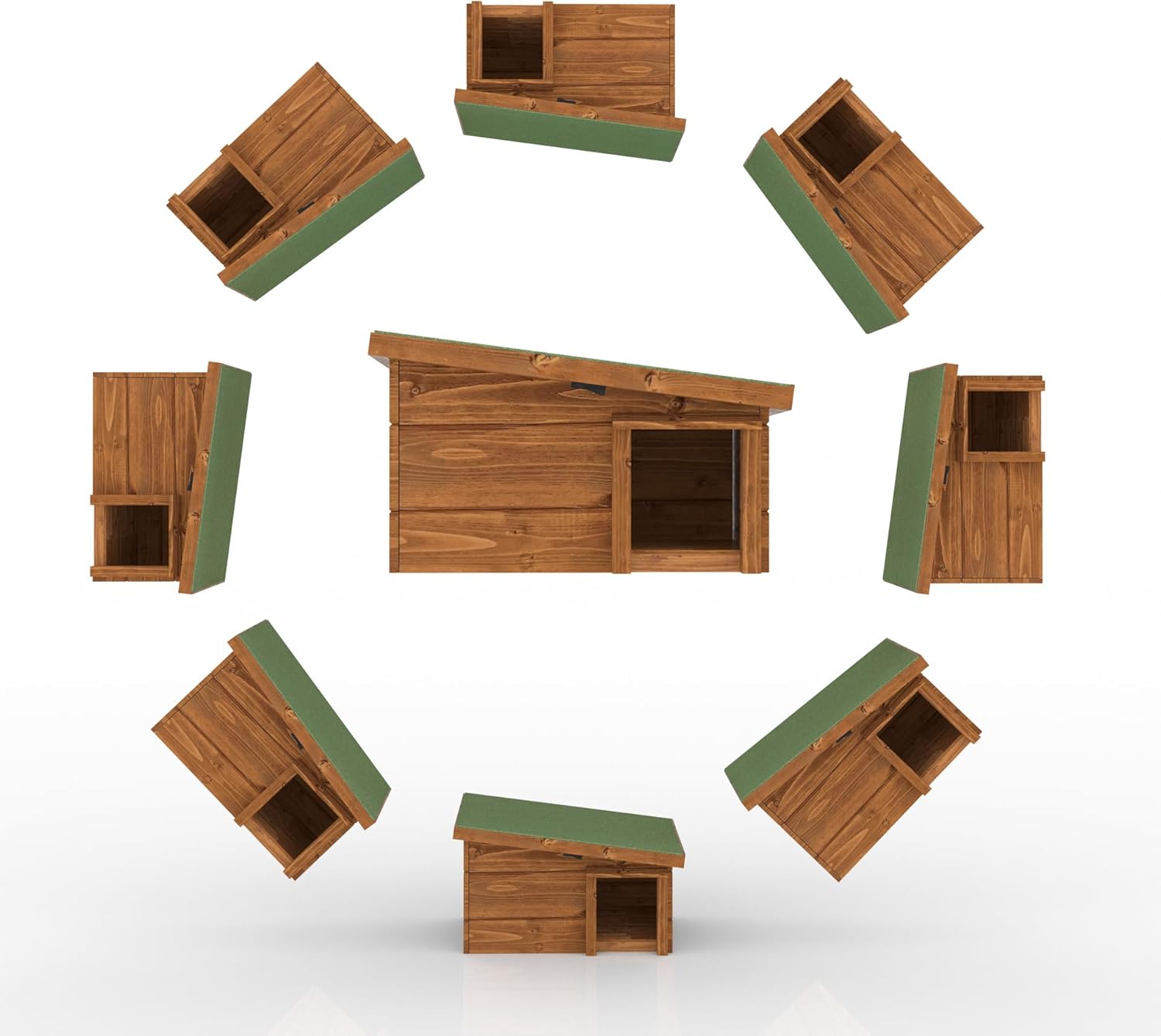
- Built to a Minimum the Wildlife Trusts Do Not Publish
- Depth Is 340 on the Bullet and 300 on the Drawing, and Nobody Prints the Inside
- A Partition Where the Trusts Draw a Tunnel, and Whose Paws It Is Meant to Stop
- What Eight Readable Reviews Cannot Tell You, and What Amazon's Tally of 5,130 Can
- Bedding, Cleaning, Disturbance and Which Way to Face It: Getting It Ready for October
- Why It Scores 4.3, and the One Reason to Pay More for the Deluxe
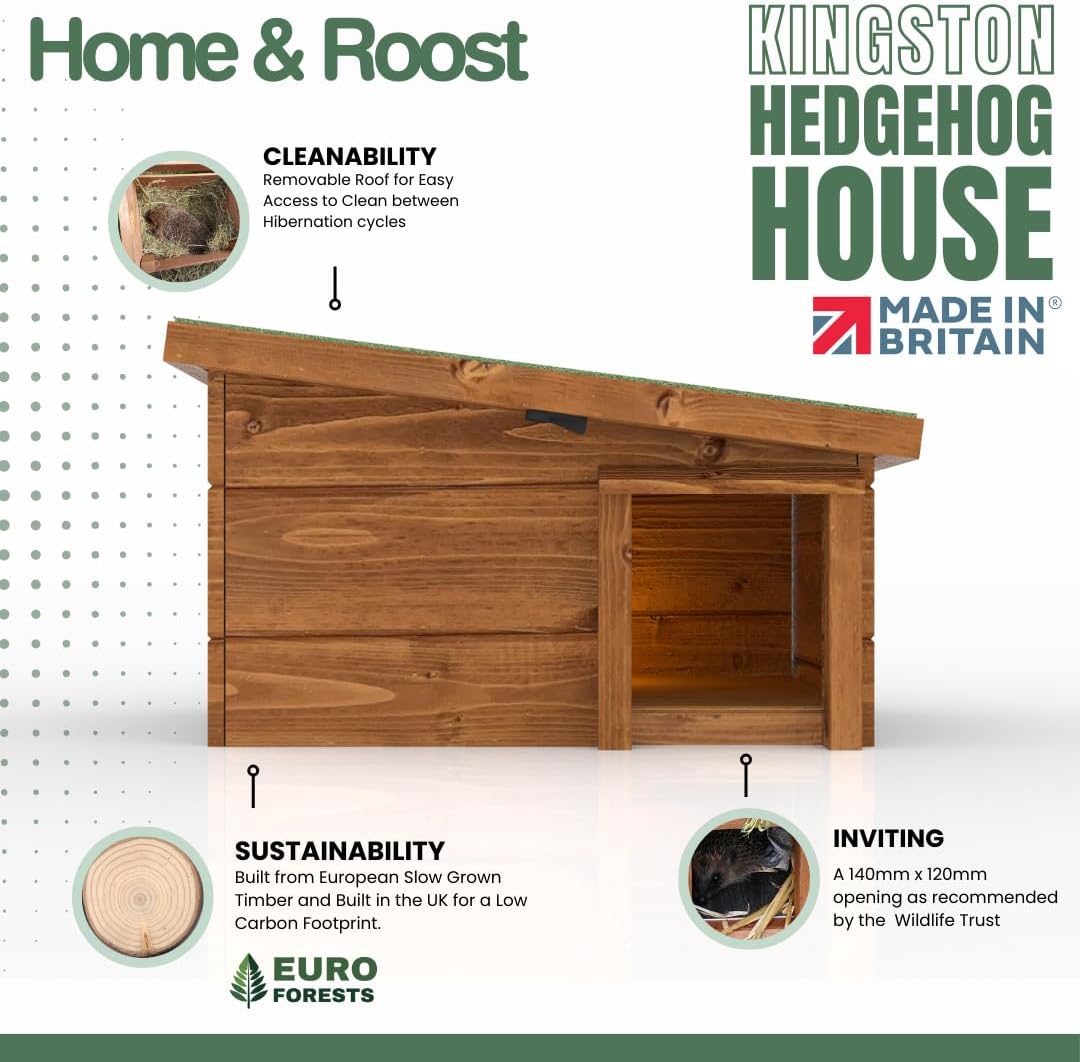
The Kingston's Amazon title says it is 'Built to Minimum Wildlife Trust Sizes', and one listing image adds 'A 140mm x 120mm opening as recommended by the Wildlife Trust'. That specification does not exist: the Wildlife Trusts publish one build plan with exact cut sizes, and no minimum. In short: the footprint matches the Trusts' plan almost exactly, the box is shorter, it has no tunnel, and two of Home and Roost's own surfaces give different depths. We score it 4.3. It suits a sheltered corner of a garden with no known badgers; if badgers visit, the same maker's Deluxe has the tunnel, with a caveat below.
Built to a Minimum the Wildlife Trusts Do Not Publish
What the Wildlife Trusts actually publish is a cut list. Their build page says 'Cut your timber to the dimensions shown': back, base and lid 40cm x 30cm, two sides 26cm x 30cm, four 8cm x 8cm feet, and a 40cm-wide front panel with an entrance notch cut up from its bottom edge. The words 'minimum' and 'at least' appear nowhere on the page. A cut list for one design is not a minimum specification, and the Wildlife Trusts are 47 independent charities, so there is no single body issuing a size a maker could build to.
Measured against that plan the Kingston does better than its wording deserves. Home and Roost's own drawing gives a 412mm by 300mm footprint, the Trusts' 40 x 30cm box within 12mm. On height it is shorter, 258mm against the Trusts' 30cm panels. And the Trusts' plan includes a 30cm tunnel with the instruction 'Don't be tempted to skip the tunnel', explained as 'it means that predators won't be able to swipe their paws inside!' The Kingston has no tunnel.
The 140mm x 120mm opening is where the claim comes apart, because the Trusts have published more than one entrance figure. Their 2021 diagram shows a 19cm wide by 17cm high aperture in the front panel; the 2015 version of the same plan, from the Royal Society of Wildlife Trusts, shows 17cm by 17cm. The tunnel that slots into that aperture is built from 17cm and 13cm boards, so its bore comes out near 13cm square. Pick the aperture and the Kingston's doorway is smaller than the Trusts'; pick the tunnel bore and it is in the same territory. What nobody can call it is 'recommended by the Wildlife Trust'. Hedgehog Street says outright that it endorses no commercial hedgehog home, because there has been no research on them.
Depth Is 340 on the Bullet and 300 on the Drawing, and Nobody Prints the Inside
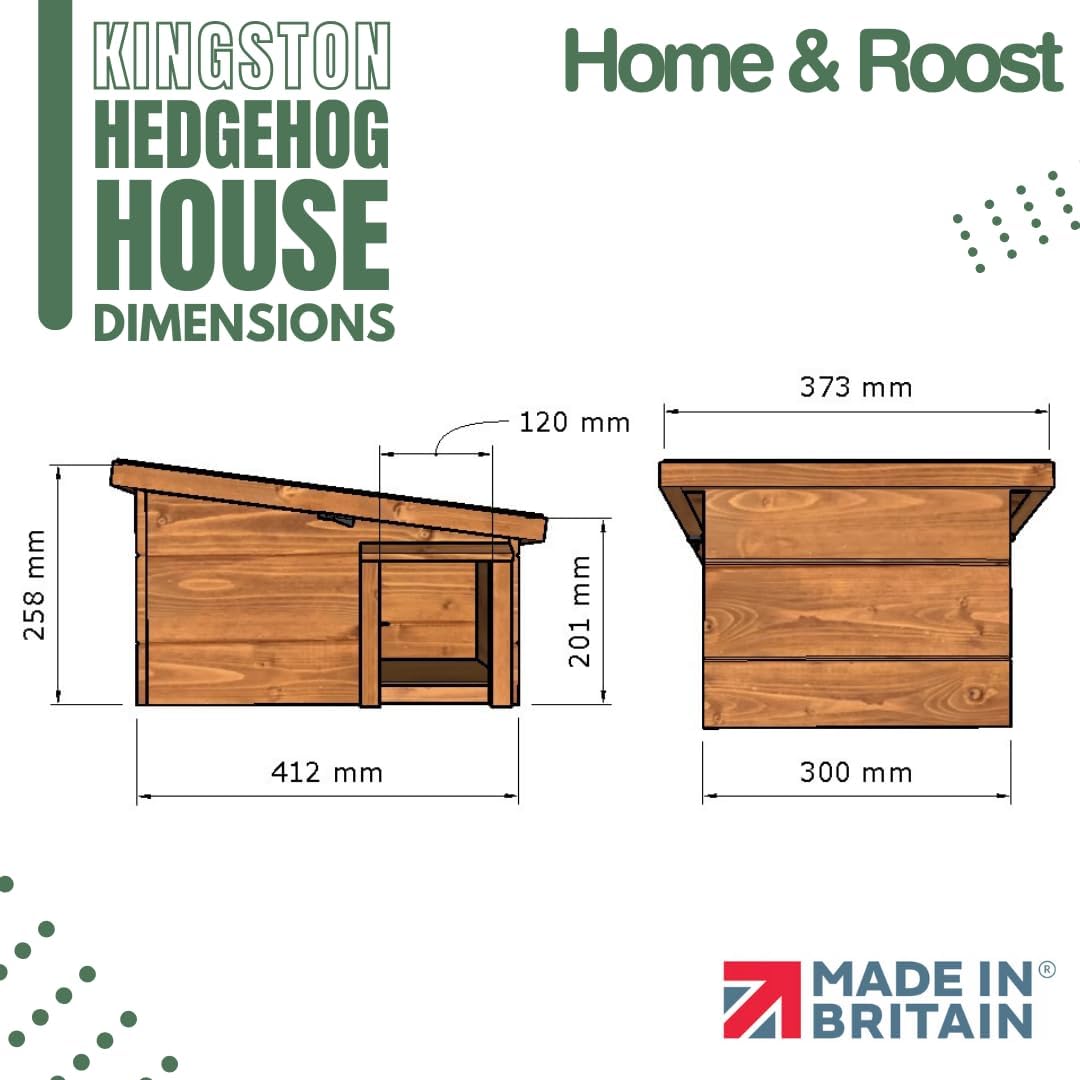
Bullet four says the house is 'constructed with a height of 260, width of 400, and a depth of 340'. No unit is printed. The package measures 46.8 x 41 x 28cm, so we read the three figures as millimetres, an inference rather than a fact off the page. The doorway does carry its unit: 'about 12cm wide and 14cm high'.
Now open the sixth listing image, the seller's own dimension drawing. It gives 258mm high, 412mm wide, a 120mm entrance opening, a body depth of 300mm and 373mm across the roof overhang. Height and width round to the bullet. Depth does not: 340 matches neither the 300mm body nor the 373mm roof. Two manufacturer surfaces, one product, and the gap lands on the attribute buyers argue about most. We do not know which is right and will not guess.
There is a second gap under that one. Every line on the drawing runs to the outside edges, while the bullet presents its numbers as the answer to 'Hedgehogs need space'. The usable floor is smaller than any published figure, the timber thickness is not published, and the partition and porch take a further share, so nobody can tell you the size of the chamber a hedgehog actually sleeps in.
No charity figure settles the size argument: none publishes a minimum. Two truncated Amazon snippets read, in part, 'It`s built well but I think it is too small', from a buyer using it in a release pen, and 'It could have been slightly bigger in the house bit', from one who wants it just for feeding. Both are partial quotes with no country tag. Against them, Beverley De Bruijn, one of our eight, titled their five-star review 'Beautifully made, perfect size and dimensions'.
A Partition Where the Trusts Draw a Tunnel, and Whose Paws It Is Meant to Stop
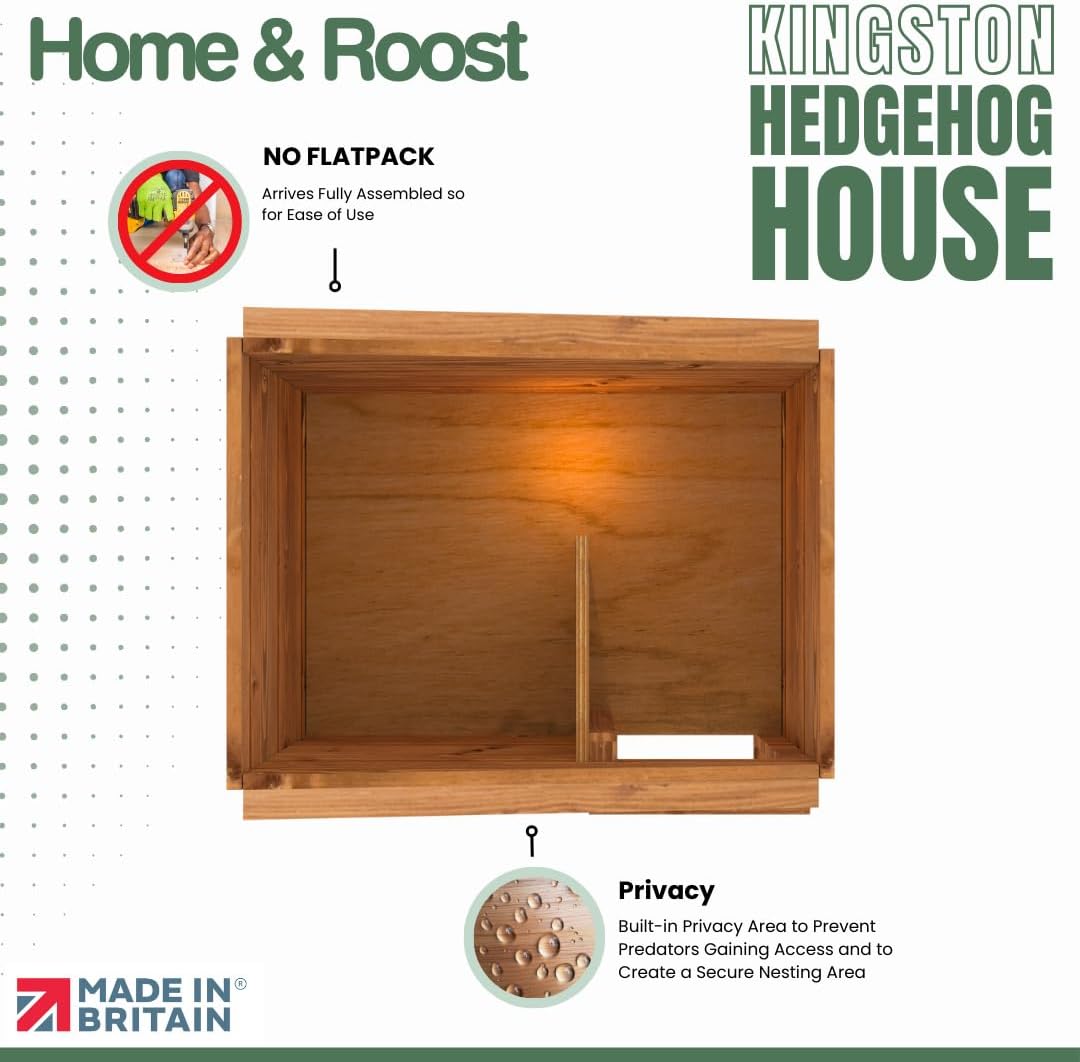
No bullet, spec row or image mentions a tunnel, and the photographs show why: the entrance is an open-fronted porch cut into the right-hand end, not a hole with a passage behind it. Home and Roost's answer to predators is inside. The interior shot shows a partition standing across the box with a gap at one end, captioned 'Built-in Privacy Area to Prevent Predators Gaining Access'. Those are the 'two chambers' MTF describes.
Three charities accept that design in principle. BHPS, on ready-made houses, suggests 'a solid construction with a base and a tunnel or internal baffle'. Hedgehog Street tells anyone whose box lacks a tunnel entrance to 'include an interior tunnel or dividing wall', so that badgers or foxes cannot reach the hedgehog with their paws. The RHS, advising buyers, accepts a 'tunnel entrance' or internal baffle 'to discourage predators'. The Wildlife Trusts, the one body named on the box, draw a 30cm tunnel and tell you not to leave it out. So the design is accepted by three charities, and the wording it borrows comes from the Wildlife Trusts, who would add a tunnel.
The title says 'Predator-Proof'. Not one source we read uses 'predator proof', 'badger proof' or 'fox proof'. Hedgehog Street names the animal that matters: badgers, which it calls hedgehogs' main predators in the UK and the only animals strong enough to tackle their spines. Cats, on the same page, are 'curious but not a big threat'.
That is the lens for Amazon's numbers. Across 5,130 global ratings, Amazon counts 166 mentions of pet resistance, 137 positive and 29 negative, 17%. The only outright complaint among the predator snippets Amazon surfaces is about cats and food: a buyer who put food in the entry part found 'it would be pinched by cats', a partial quote. Two other snippets praise the box, one for roof catches a dog cannot flip off, one calling it 'cat proof'. No snippet mentions a badger. Among our eight, Shaun Morris, five stars, adds: 'Partition inside could be more secure though, bit flimsy and can see it breaking easy.'
Kingston Hedgehog House and Hibernation Shelter
A fully assembled, Kent-built box with a toggled removable roof, a solid floor and an internal baffle, on a footprint that matches the Wildlife Trusts' own plan to within 12mm.
What Eight Readable Reviews Cannot Tell You, and What Amazon's Tally of 5,130 Can
Logged out of Amazon, we could read only the eight cards the product page showed, and how Amazon picks those we do not know. All eight are UK verified purchases dated 19 November 2023 to 2 September 2026, six from 2026, and they average 4.88: seven five-stars and one four. The lifetime badge is 4.7 from 5,130 global ratings, 83% of them five-star and 4% at three stars or below, and our sample holds none of that 4%.
What the eight agree on is the build. Seven use 'well made', 'well built' or 'build quality'; the eighth, Marraduse, calls it 'robust and functional' and gives four stars because 'I don't think it's quite worth the price but this was a close thing'. MTF has the line that matters here: 'Time will tell if it provides hibernation habitat', and reports an infra-red camera filming the hog every night. Nobody among the eight reports a hedgehog hibernating through a winter in it.
Amazon's tally covers what the whole rating base mentions, the balance the eight cannot give. Six rows run between 1% and 4% negative, quality 2% across 1,067 mentions and value for money 4% across 461. The other two decide whether a box works in winter: size, 197 mentions with 44 negative, 22%, and pet resistance at 17%. Against 5,130 ratings, 44 complaints is small in absolute terms; the finding is the contrast between rows, and we cannot read those reviews.
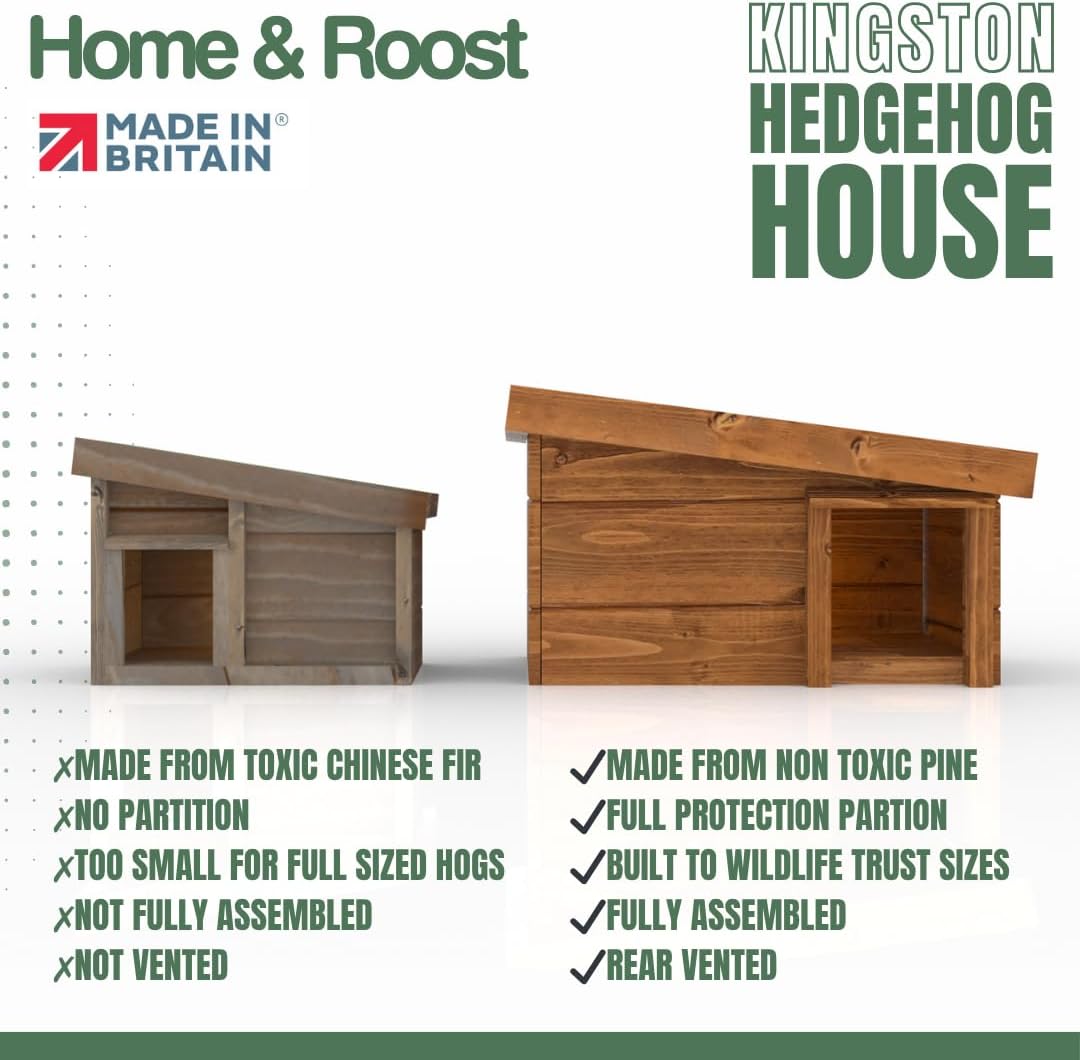
The second listing image is awkward here. Home and Roost's comparison chart crosses a greyed-out, unnamed rival for being 'TOO SMALL FOR FULL SIZED HOGS', and size is the row where its own listing collects 44 negative mentions. Three of the snippets also show the box bought or planned as a feeding station. BHPS says it is 'best not to offer food inside the home (except perhaps to tempt them in initially)', and once there is a resident, 'move food away from the box so as not to attract predators or rival hedgehogs'.
Bedding, Cleaning, Disturbance and Which Way to Face It: Getting It Ready for October
Hedgehog Street puts hibernation at 'October/November through to March/April'. The box arrives fully assembled, so it can go out now, and the Housing Census that Hedgehog Street reports found houses more likely to be used the longer they had been in place; 57% of the monitored houses had been used for hibernation, though respondents could only say whether a house had ever been used, not how often.
Bedding is where two of our eight and the charities all disagree. Marraduse: 'Don't fill it with bedding - hedgehogs prefer to make their own nest.' M Summerell would 'furnish the internals with some straw'. BHPS says to leave dry leaves outside for the hedgehog to take in; the Wildlife Trusts say 'put the dry leaves inside'; Hedgehog Street permits both and, citing the Census finding that bedding had a positive effect on use, recommends 'Provide bedding such as straw or leaves', but not once they are hibernating.
On cleaning, the box's own advice differs from the charity it names. Bullet three says clean 'in April and October'. The Wildlife Trusts say once a year, 'late March to early April', and BHPS gives the same spring window; Hedgehog Street's cleaning page and the RSPB allow both months, and the RSPB calls October 'the ideal time'. All agree with BHPS's capitals: 'DO NOT CLEAN IF A HEDGEHOG IS IN RESIDENCE.'
BHPS's FAQ widens that beyond cleaning: 'Never disturb a sleeping or hibernating hedgehog or open a nest box that is in use.' Hedgehog Street says why: disturbance then 'can be extremely dangerous, as hedgehogs use up their precious energy reserves'. Check without opening: the RSPB puts 'a scrunched-up piece of newspaper' at the entrance, and moved by morning means someone is home. BHPS wants it unmoved over 'several days/nights' before calling it empty.
Siting: BHPS says the entrance should not face 'North or North East'; Hedgehog Street wants houses 'in sheltered locations, along boundaries, in back gardens and within 5m of the house', and the RHS says to cover the roof 'with vegetation, leaves or logs'. The Census found houses less likely to be used if the entrance faced the open, if a pond was present, and if dogs were present, the dog effect showing during hibernation. Think twice before netting a pond this autumn: our pond cover net review carries ARC's warning that hedgehogs 'can get caught in such netting too'. M Summerell suggests gluing feet under the base to lift it off damp ground; the Trusts' plan has four; the Kingston's drawing shows none.
Why It Scores 4.3, and the One Reason to Pay More for the Deluxe
Three things hold the number up. The eight cards say 4.88 and we discount them for running hot. The badge says 4.7 with 96% of ratings at four stars or above, and Amazon's tally puts construction at 1% negative across 794 mentions. These pull it down: size and pet resistance at 22% and 17% negative; no tunnel where the charity it names draws one; a box shorter than that charity's plan; and a bullet and a drawing that give two different depths. Bullet six calls it 'twin treated with an anti-bacterial water based coating': water-based is the only kind BHPS permits, though BHPS allows it 'only on the outside' and the listing never says which surfaces. Hedgehog Street prefers untreated wood. 4.3: a well-built box whose paperwork is worse than its joinery.
Who should think twice: the reader who knows badgers visit. If you would rather have the tunnel the Wildlife Trusts tell you not to skip than the baffle three charities accept, buy The Hutch Company's Deluxe Ventilated Predator Proof Hedgehog House and Hibernation Shelter instead: same maker, an access tunnel listed at 360 deep, millimetres again, a ventilation tube, 4.6 from 426 ratings. It is dearer; a reviewer who owns both says 'the tunnel and house have no partition'; and on Amazon's tally, which files the Deluxe's row under 'predator resistance' and the Kingston's under 'pet resistance', the Deluxe runs 19 positive to 16 negative, 46%, against 137 to 29. 35 mentions against 166 is not a controlled comparison, and both complaints we can read are about cats, one calling it 'the perfect size for cats'. Still, it is the opposite of what a tunnel upsell implies.
For a sheltered corner of a garden with no known badgers, the Kingston is the cheaper box, it arrives assembled, and three charities accept the baffle it uses instead of a tunnel. Put it out now, face the entrance away from north and north-east, put a handful of dry leaves inside and leave more beside it, no food inside once someone moves in, and keep the roof on until spring.
Kingston Hedgehog House and Hibernation Shelter
A fully assembled, Kent-built box with a toggled removable roof, a solid floor and an internal baffle, on a footprint that matches the Wildlife Trusts' own plan to within 12mm.