Long Handled Bulb Planter for Clay Soil UK: The Warning Buried in a Five-Star Review
We earn commission from qualifying Amazon purchases. It costs you nothing and does not affect what we recommend.
Heavy clay is where cheap bulb planters bend, stick or simply stop. An all welded steel tube with a foot plate should be the answer, so why does one five-star buyer warn you off using it on dry ground?
- Steel, a Foot Plate and Three Depth Settings
- Thirteen Reviews, Twelve of Them Five Stars
- Timing Beats the Tool on Hard Ground
- Does the Core Drop Out, or Pack Into the Barrel?
- Weight, Reach and an Edge That Sharpens Itself
- The Other Four Jobs in the 5-in-1
- Our Score, and Who Should Buy Something Simpler
Late August clay is where a cheap bulb planter gives up. The barrel goes in an inch, stops on ground that has set like fired pottery, and the handle flexes before the soil does. Clay is the reason a lot of UK gardeners end up buying a second bulb planter.
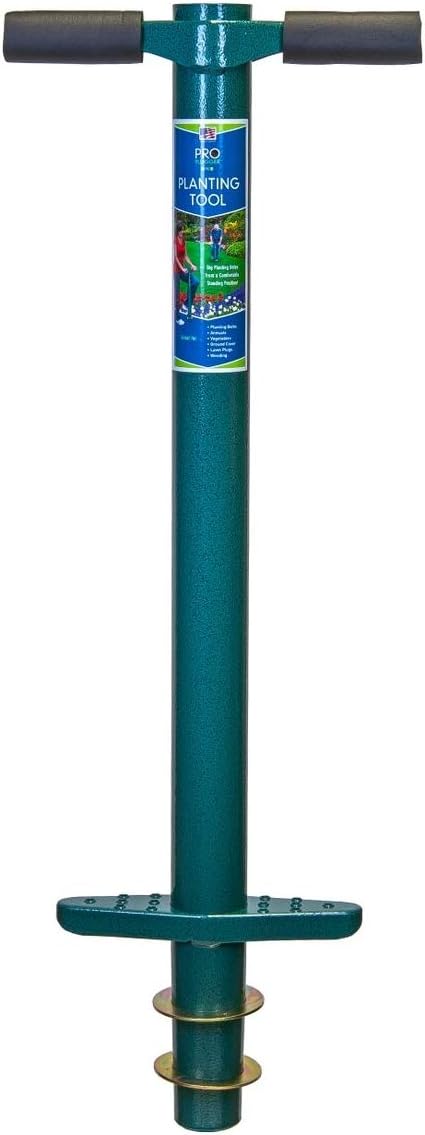
The ProPlugger 5-in-1 is where plenty of them land. It is a long steel tube with a T-bar handle, a welded foot plate you stand on, and depth rings that set the hole at 2, 4 or 6 inches. On paper it is built for exactly the ground that defeats plastic. Whether it beats British clay is a more interesting question than the listing admits, and the most useful answer sits inside one of its five-star reviews. Check the current listing if you want the spec open alongside this.
Steel, a Foot Plate and Three Depth Settings
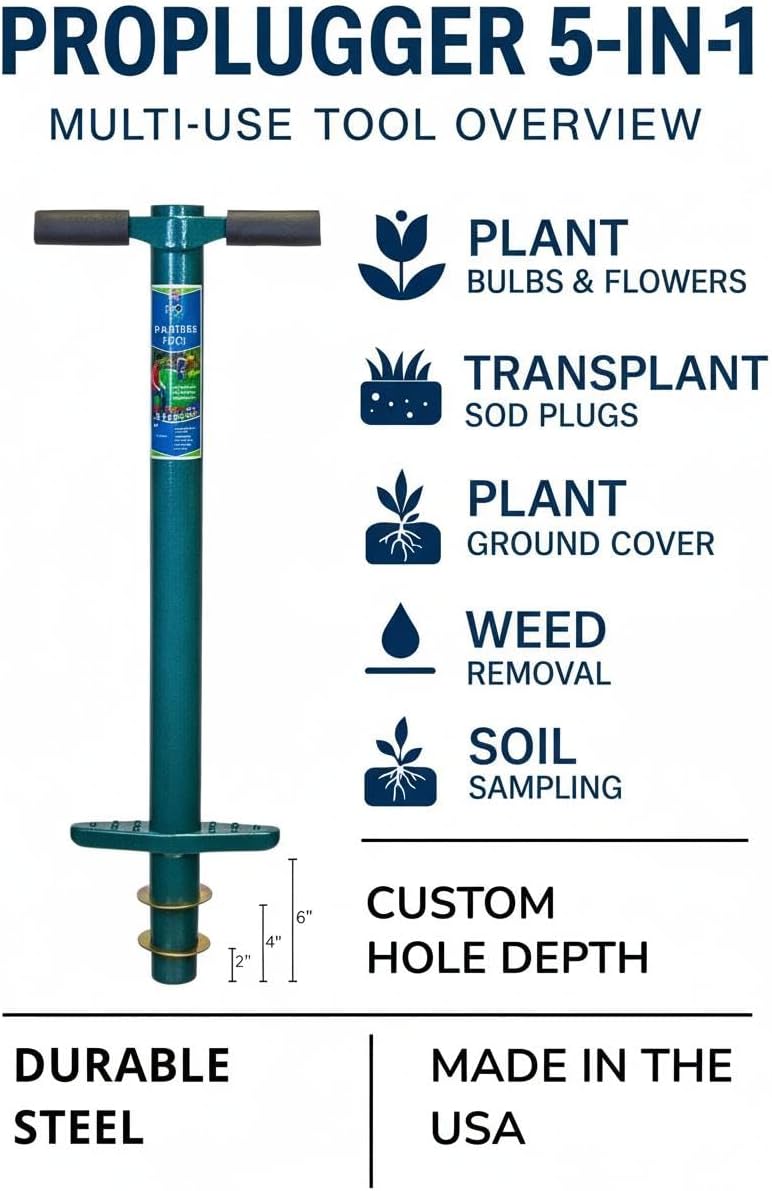
The listing keeps the spec short: 100% steel with a powder coated finish, made in the USA of all welded carbon steel. That last phrase does more work than it looks. On budget long handled planters the failure point is almost always the joint where the barrel meets the shaft, the spot taking the twist every time you lever a core out. Welded through, there is no joint to give way.
The listing infographic sets out the depth system. Two brass collars sit on the barrel, and the callouts mark three hole depths at 2, 4 and 6 inches, so roughly 5cm, 10cm and 15cm. That covers the usual UK rule of planting a bulb two to three times its own height deep: crocus and snowdrops at the 5cm setting, most alliums and smaller narcissi at 10cm, and full-size daffodils and tulips at 15cm, which is the depth that keeps tulips coming back rather than fading after one spring.
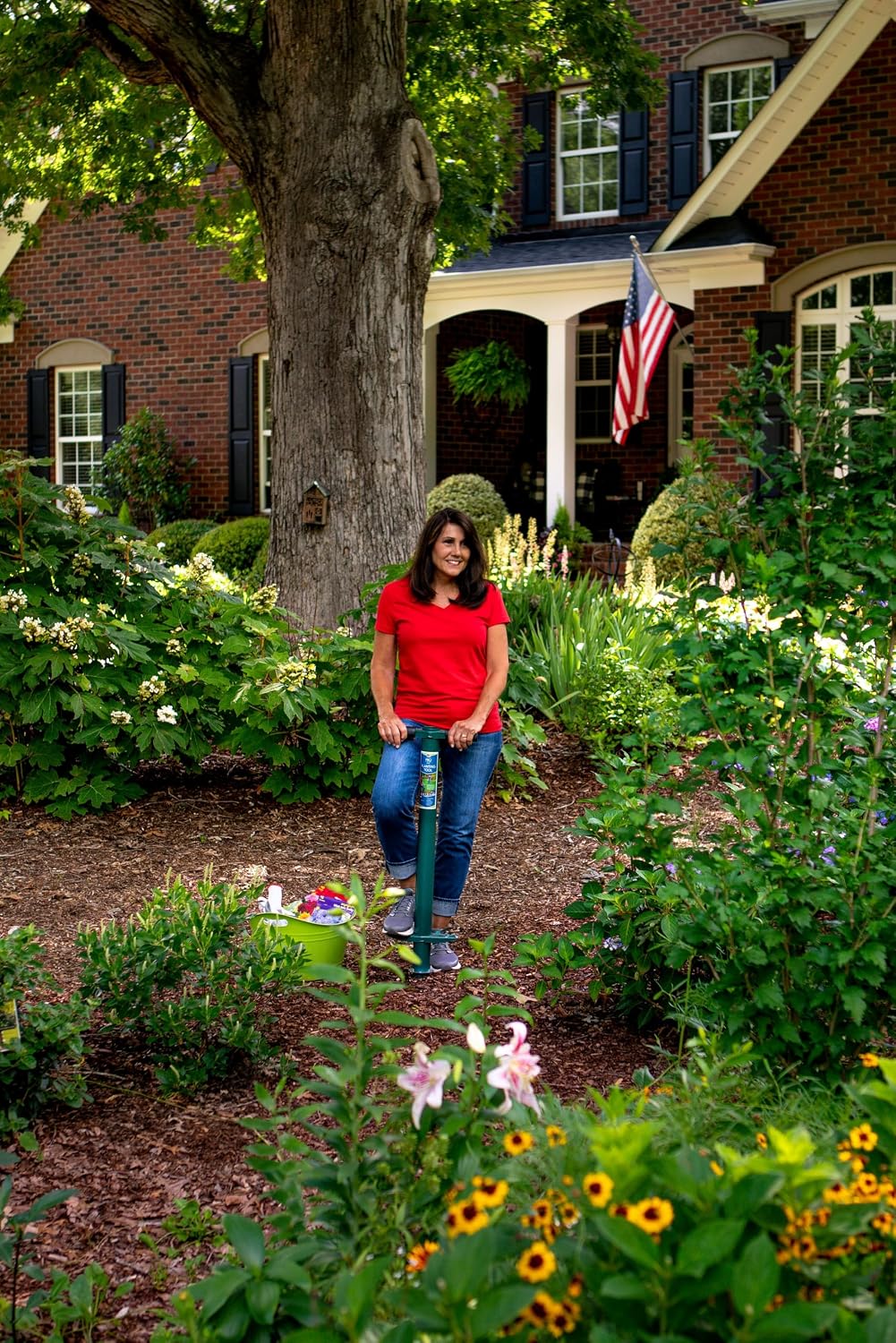
The foot plate is the part that matters on heavy ground. It is a welded oval with a dimpled top for grip, wide enough to take a boot, and it lets your body weight drive the barrel instead of your shoulders. Above it, a T-bar with two foam grips gives you the leverage to twist and pull the core free.
What the listing never states is worth knowing too. There is no weight figure, no barrel diameter and no overall length anywhere in the text or the images. Diameter matters most, because it decides how big a core you cut, and in clay that governs how hard the tool is to pull back out.
Thirteen Reviews, Twelve of Them Five Stars
A straight word on the evidence before any of it gets used. Amazon would only surface 13 reviews on this listing, far fewer than we normally get to read, and those 13 are not a cross-section. Twelve are five stars, one is four, and there is not a single 1, 2 or 3 star review among them. Eight came from the United Kingdom, with one each from Australia, Italy, Germany, Spain and the United States. A sample with no critical reviews in it cannot be read as an average, so nothing below tells you how often this tool disappoints anybody. The listing's lifetime record, 4.6 stars from 7,478 ratings, is the number carrying that information, and it sits well below the 4.92 our 13 average out at.
What the 13 do give you is scale. Four put a number on a bulb planting run. John Joseph Nevans, whose review carries 41 helpful votes, added a note once he had finished: “The last picture shows the tool after planting 4700 daffodil bulbs in my front garden. It has lost the nice paint job but is still one hundred percent effective.” b_wildered2 is briefer: “I planted 350 bulbs in a morning with this tool. It’s rock solid and will last a lifetime.” Mr. S. Wood counted 600 bulbs, Zoe counted 160 into a lawn.
The split inside the sample is the more revealing part. Six of the 13 describe planting bulbs. Another six describe something else entirely: lifting unwanted bulbs out of turf, plugging lawns, digging out weeds. One, from Australia, never says what the job was. For a tool sold first as a bulb planter, roughly half the readable feedback is about other work.
Timing Beats the Tool on Hard Ground
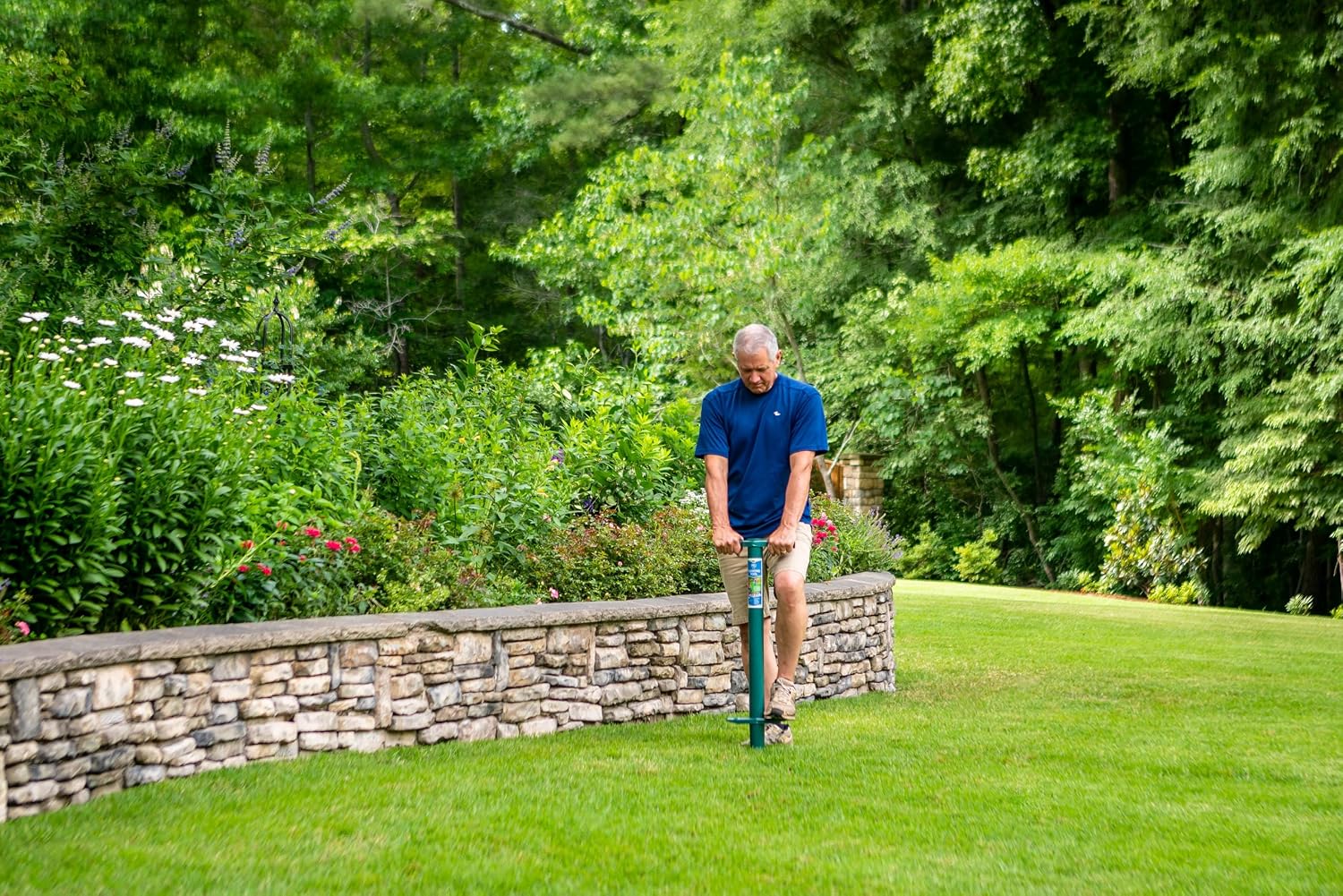
The most useful sentence in all 13 reviews is a throwaway line at the end of a five-star one. Mr. S. Wood, who planted 600 bulbs with it and says it saved his back, finishes with this: “Like all of these tools trying to use it on dry ground can be next to impossible.” That is not a complaint about the ProPlugger. It is a limit on the whole category, and it lands squarely on clay.
Be clear about what the reviews do not say: not one of the 13 uses the word clay. Nobody reports planting into a heavy Midlands border, and nobody reports failing to. What you have instead is a build specification that suits heavy ground, plus a dry ground warning from someone who has worked the tool hard, and baked summer clay is the textbook case of dry ground. Reading across from one to the other is our inference rather than reviewer testimony, and it should be weighed as such.
The practical consequence for a clay garden is that timing matters more than the tool. Spring bulbs go in between September and November, and on clay the window you want is after the first proper autumn rain has softened the top 15cm, before winter waterlogs it. If the ground has set hard, no planter fixes that. Wait for rain.
The opposite mistake costs you bulbs. Driving a steel tube into saturated clay glazes the sides of the hole, and a smeared hole drains like a bucket. Drop a handful of grit into the base before the bulb goes in, and backfill with the core you cut rather than loose compost, or you have built a sump that rots the bulb over winter.
ProPlugger 5-IN-1 Planting Tool
Welded carbon steel, a foot plate and three depth settings: the specification heavy ground actually asks for.
Does the Core Drop Out, or Pack Into the Barrel?
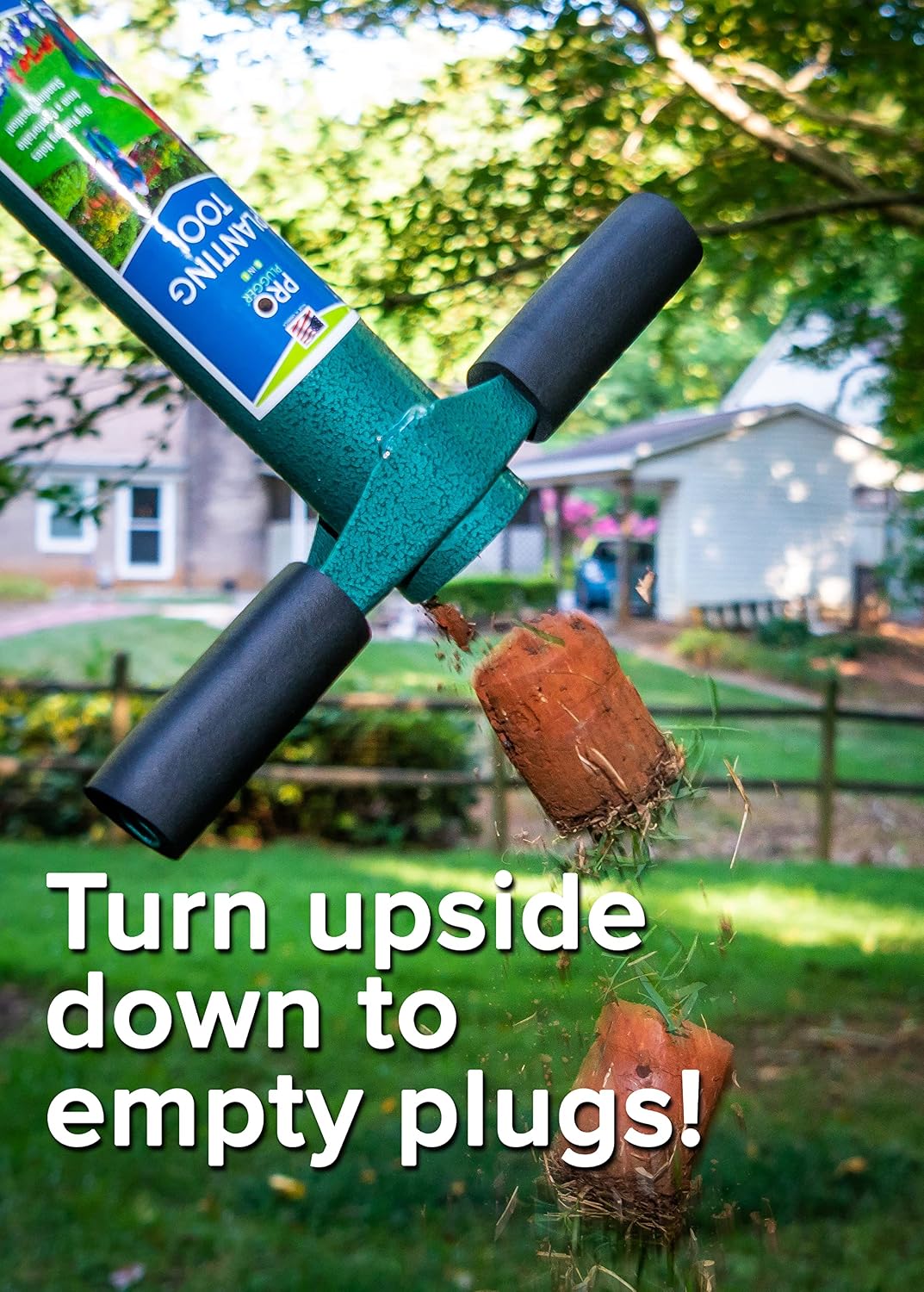
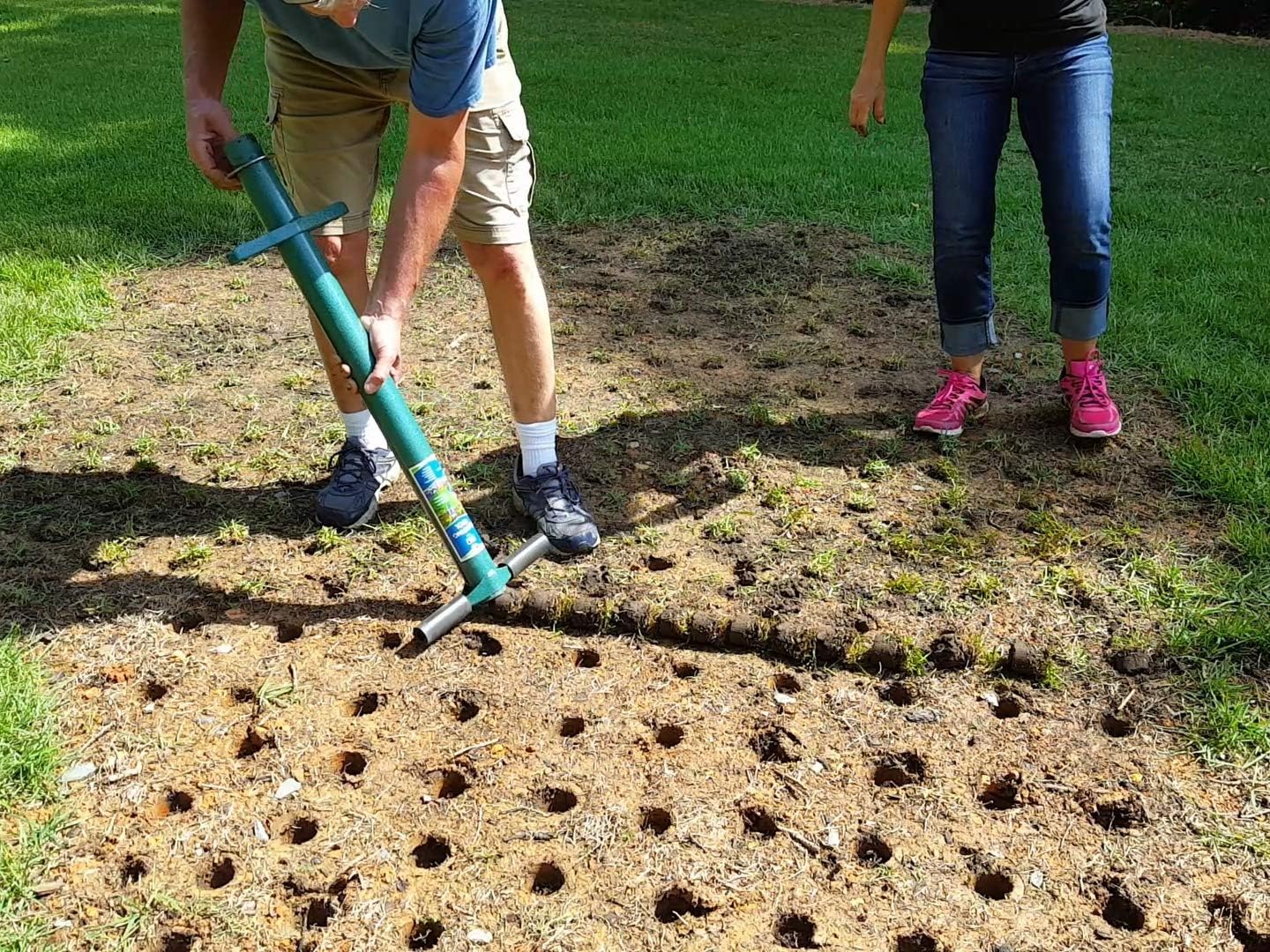
The listing makes emptying sound trivial. Soil stacks up inside the tube as you dig, and the listing says to “Empty it by simply turning it upside down”. The product photo for that step carries the caption “Turn upside down to empty plugs!” and shows two intact cores dropping clear of the barrel. It is also a manufacturer photo, and manufacturer photos never show the core that jams.
This is the claim worth pushing on if you garden on clay, because wet clay is the soil that packs into a tube and stays there. Nevans opens his answer by naming the complaint: “Others mention that the plugs aren’t formed when they leave the tube, I would suggest that the soil you are planting in is cultivated and you don’t need this for that kind of planting, my plugs are perfect as the picture shows, easily taken out and pushed back in.”
Read that carefully, because it cuts both ways. He is acknowledging that other buyers have reported cores failing to hold their shape, and those are buyers our sample cannot show you. His explanation is that the tool is wasted on already-cultivated soil, which is the loose end of the scale rather than the clay end. It does not settle what happens in wet clay.
The workflow the reviews describe is worth copying. Mr. S. Wood points out that as long as you keep every hole to the same depth, a core cut in one spot drops neatly into any other, so on a lawn you cut, drop the bulb in, then plug that hole with the core from the next one along. Work while the clay is damp and crumbly rather than sticky and those cores hold together far better.
Weight, Reach and an Edge That Sharpens Itself
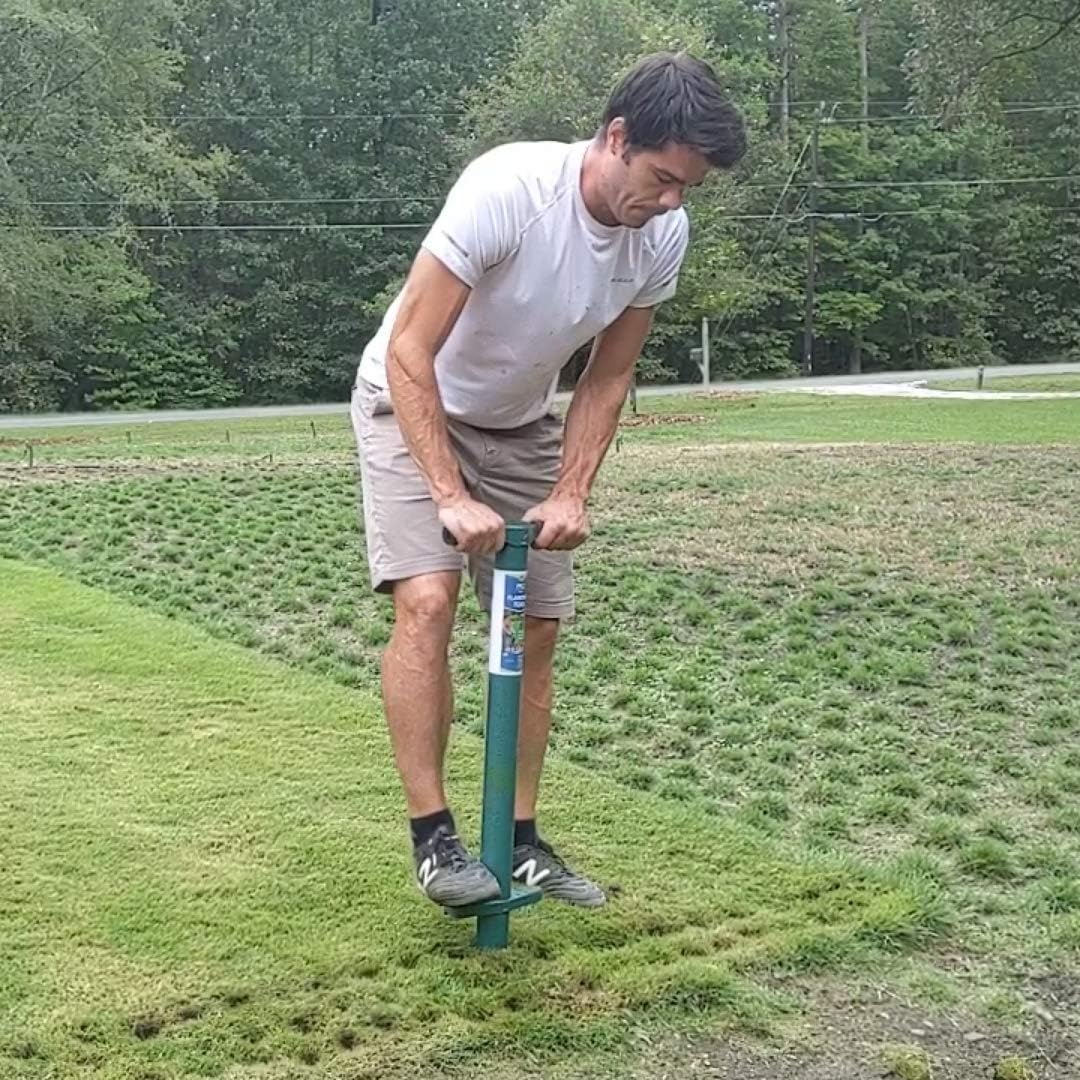
Seven of the 13 reviewers reach for the same handful of words: solid, sturdy, robust, well made, heavy duty. Nevans is the one who explains why the heft is the point rather than a flaw: “solidly made and as some reviews mention heavy but that is part of its effectiveness, all you are doing is placing it pushing it down with your foot and twist/pulling it back out”. On clay that mass is doing real work, because a light barrel skates off hard ground instead of biting into it.
The listing gives no weight in kilograms, so nobody ordering knows what is turning up. Working height is easier to pin down. Nevans is 6ft 2in and describes the handle height as just right, with no bending to get bulbs in, and the listing photos agree: on a standing adult the T-bar sits at around hip height. Well under six foot and that handle sits higher on you, which is worth a thought before you commit.
Sharpness is the difference nobody advertises. Graham H switched for exactly that reason: “I have a long handled bulb planter that I was struggling with because it isn’t all that sharp.” The same review reports much less effort planting dozens of bulbs for a community volunteer scheme. Nevans found the cutting end improves with mileage, answering an earlier report of damage with “mine has sharpened up after successive use and improves the tools performance.”
The clearest effort comparison comes from cocokazzy, the only four-star review, who was lifting unwanted bulbs out of a new lawn rather than planting any. Roughly 100 came out by hand over about three hours before blisters stopped play. About 100 more came out in about 45 minutes with the ProPlugger.
The Other Four Jobs in the 5-in-1
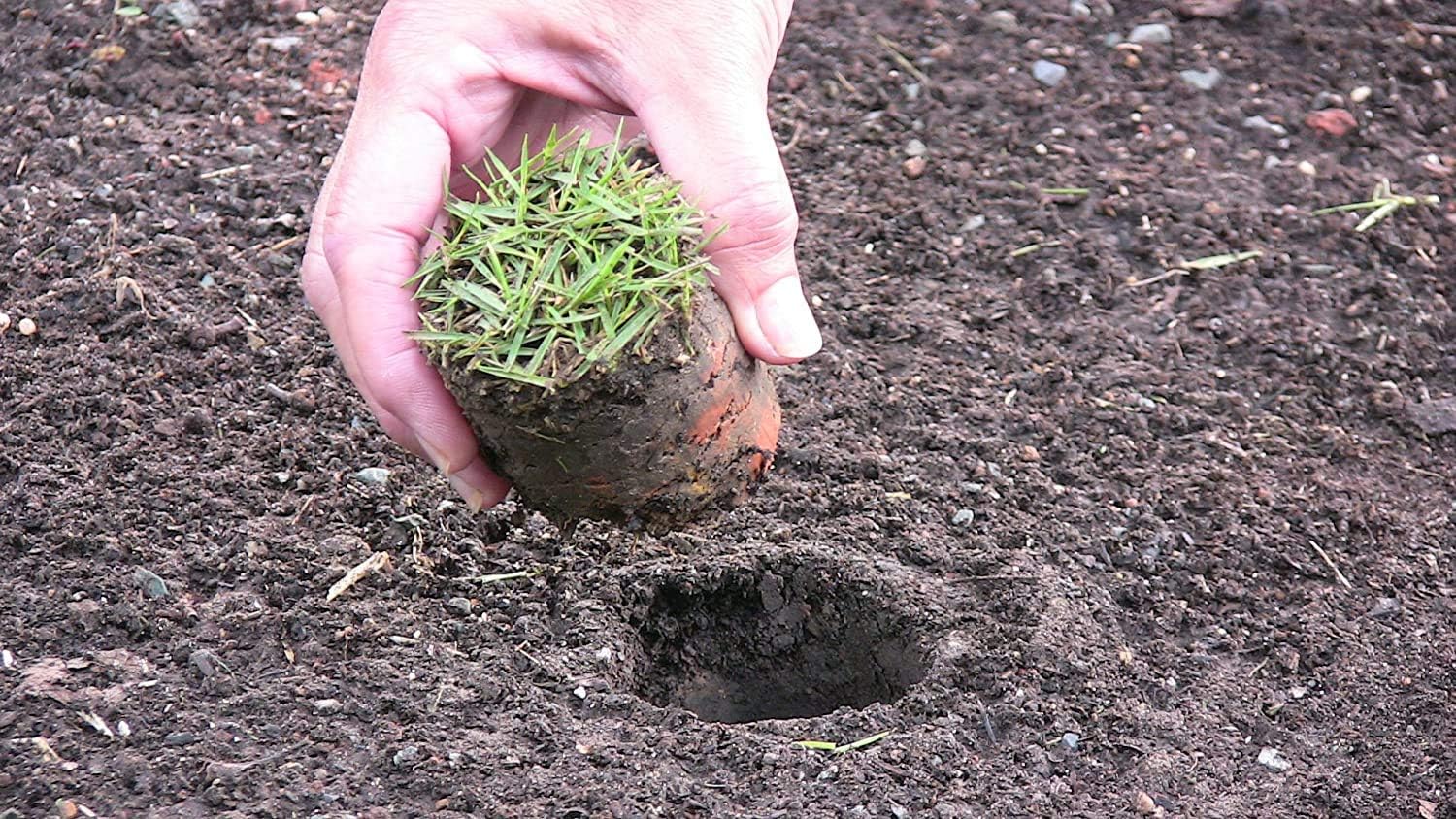
The five jobs in the name are planting bulbs and flowers, transplanting sod plugs, planting ground cover, weed removal and soil sampling, and the listing infographic lists all five. Six of our 13 reviewers use it for something other than bulbs, and those reports are the sample's clearest evidence on how the cutting action behaves.
Brian uses it on his lawn to re-turf dog urine spots, and says it is easy to use and empties well. A buyer in Italy, writing in Italian, rates it for much the same job, lifting good turf from hidden corners of the garden to patch burns left by dog wee. A reviewer in Germany, writing in German, bought it purely as a weeder for dandelions in the lawn and reports being more than satisfied. A reviewer in Spain, writing in Spanish, moves lawn and wild thyme plugs with it, pulls weeds out root and all, and sets lettuce, cabbage and tomato seedlings into the veg patch. In the United States, Dtae moved about 35 Zoysia plugs in roughly 25 minutes and reports the cores coming out intact with a solid root ball.
Useful as that is, none of it is evidence about planting bulbs in a British border and it should not be read that way. Amazon pools review cards across a listing’s variants. These are all the same 5-in-1 tool used differently rather than different products, but a turf-plugging job tells you nothing about how the barrel behaves cutting 15cm into clay for a daffodil. Zoysia is not a UK lawn grass.
What does carry across is the mechanic. Cutting a clean core and returning it in one piece is the same action whether you are moving turf or planting a bulb, and on that narrow point the sample is consistent.
Our Score, and Who Should Buy Something Simpler
We are scoring this 4.3 out of 5, deliberately under the listing's lifetime 4.6. That verdict rests on 13 readable reviews set against a lifetime record of 7,478 ratings, which is a thin base, and every critical voice had been filtered out of those 13 before we saw them. Scoring a tool above its own lifetime average on a sample containing no complaints would be the wrong call.
What holds the score up: all welded carbon steel, a foot plate that puts your body weight through the cut, three depth settings covering everything from crocus to tulips, and repeat heavy use across the sample with nobody reporting a structural failure, including the buyer who put 4,700 bulbs through it. What pulls it down: no direct clay testimony anywhere in the reviews, a documented limit on dry ground, a powder coat that comes off under a real workload, no stated weight or barrel diameter, and one buyer pointing out this is not the cheap option.
Buy it if you plant bulbs by the hundred, if kneeling is the part of bulb planting you dread, or if you are patching and plugging turf as well as planting. Skip it if your soil is already light and cultivated, since Nevans says outright you do not need this for that kind of planting, or if you put in a couple of dozen bulbs a year. And if your clay has gone hard, the answer is not a heavier tool. It is waiting for rain.
ProPlugger 5-IN-1 Planting Tool
Welded carbon steel, a foot plate and three depth settings: the specification heavy ground actually asks for.