
Roundup Fast Action Pump 'N Go 5L Review: A Strong Formula and a Patchy Sprayer
We earn commission from qualifying Amazon purchases. It costs you nothing and does not affect what we recommend.
Roundup's 5L Pump 'N Go is the UK's best-selling weedkiller for good reason, but the sprayer that makes it convenient is also the bit most likely to let you down.
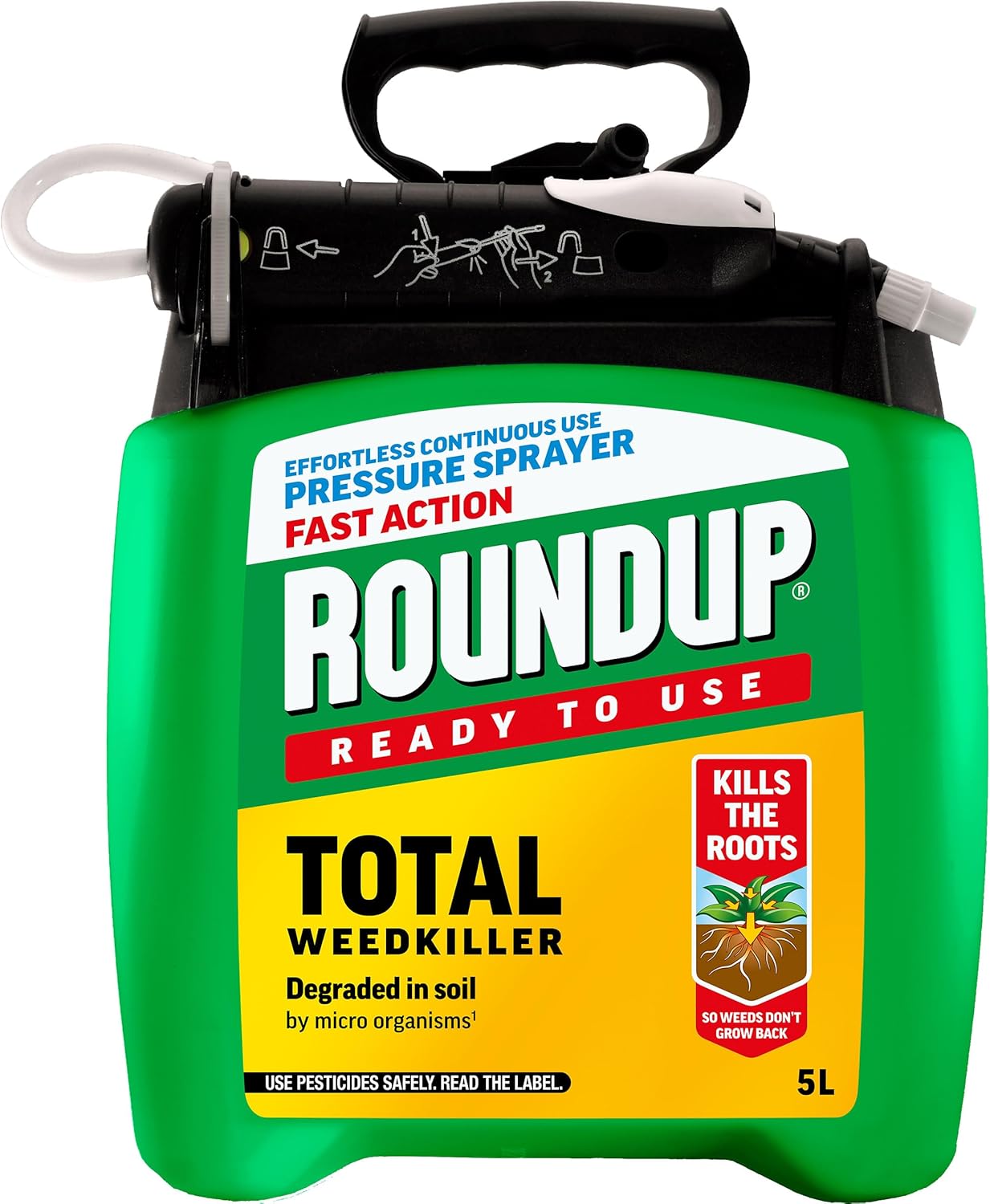
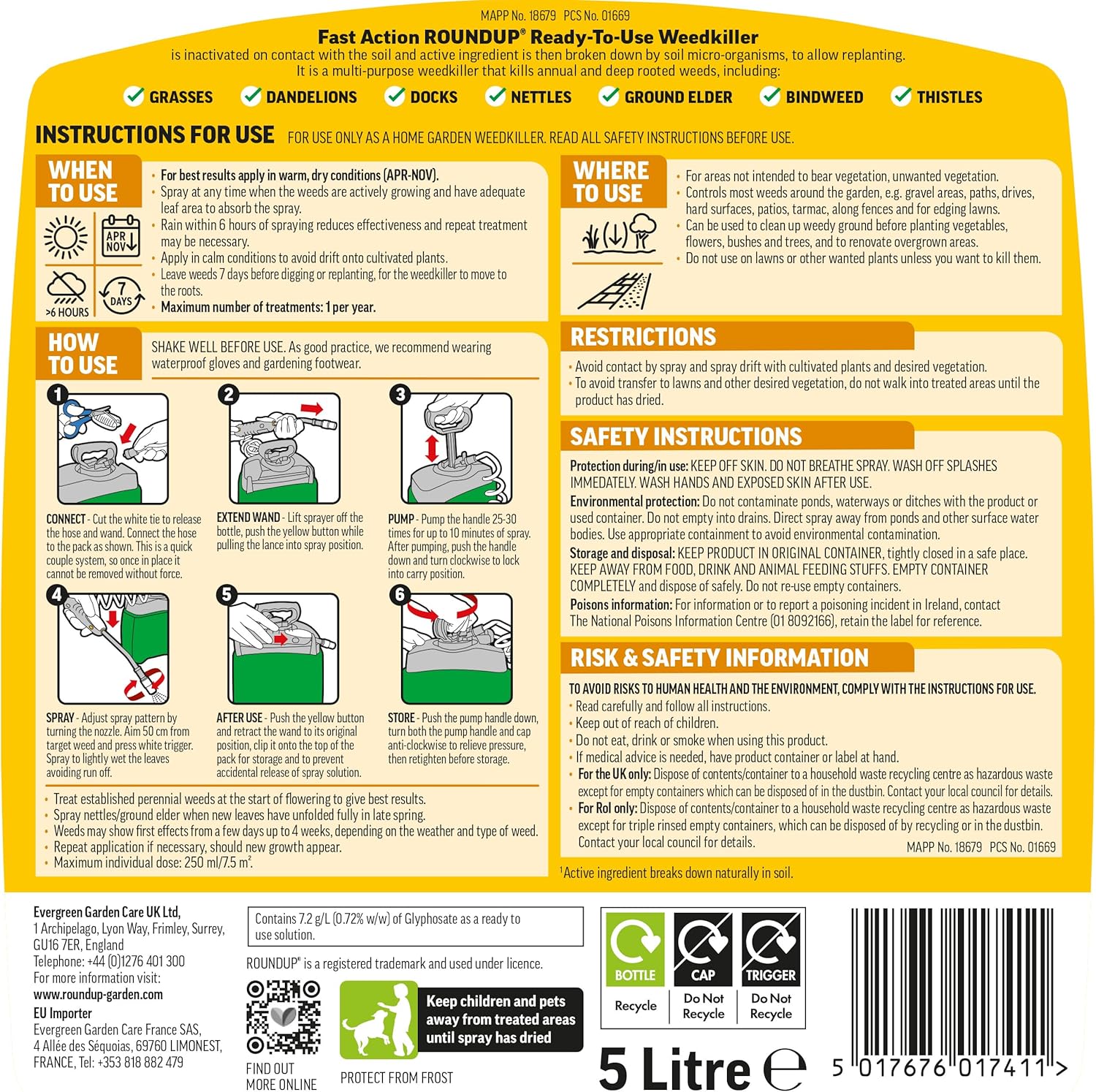
If you're looking at Roundup Fast Action Pump 'N Go, you probably already know roughly what it is. A 5-litre ready-mixed glyphosate spray with a pump-action handle, currently sitting at #1 in Weed Killers on Amazon UK and shifting over 8,000 units a month. The active ingredient is 7.2 g/l glyphosate, the formulation is MAPP 14481 approved for home use, and most weeds start yellowing within a day or two. That much is covered on the bottle.
What the bottle doesn't tell you is that the product is really two things welded together: a weedkilling formula that most UK gardeners rate very highly, and a plastic pressure sprayer that a worrying number of buyers say arrived broken, stopped pumping, or leaked out of the box. If you read the 1 and 2-star reviews in order, a pattern shows up fast, and it's almost always about the hardware, not the chemistry. So that's the lens this review uses.
Unboxing and First Impressions
For £29.99 (down from an RRP of £46.49) you get a 5-litre bottle of ready-to-use glyphosate solution with an integrated pump handle and an extendable lance that clips onto the side. No decanting, no measuring caps, no watering-can maths. You press the handle down a few times to pressurise the container, squeeze the trigger, and walk along spraying.
The ergonomic pitch checks out in the reviews. Amanda Payne, who has mild arthritis in her hand, wrote that she "was able to cover the whole patio quicker than I would have if I had only a manual spray bottle." James Callcut put it shorter: "No bending. Good value." This is a big selling point and it comes up repeatedly from older buyers and anyone with back or joint problems.
The solution itself looks slightly creamy rather than clear. A few reviewers pointed out that's useful because you can see where you've already sprayed without guessing. On a patio with dozens of little cracks, that's more helpful than it sounds.
Speed of Kill: Hours to Days
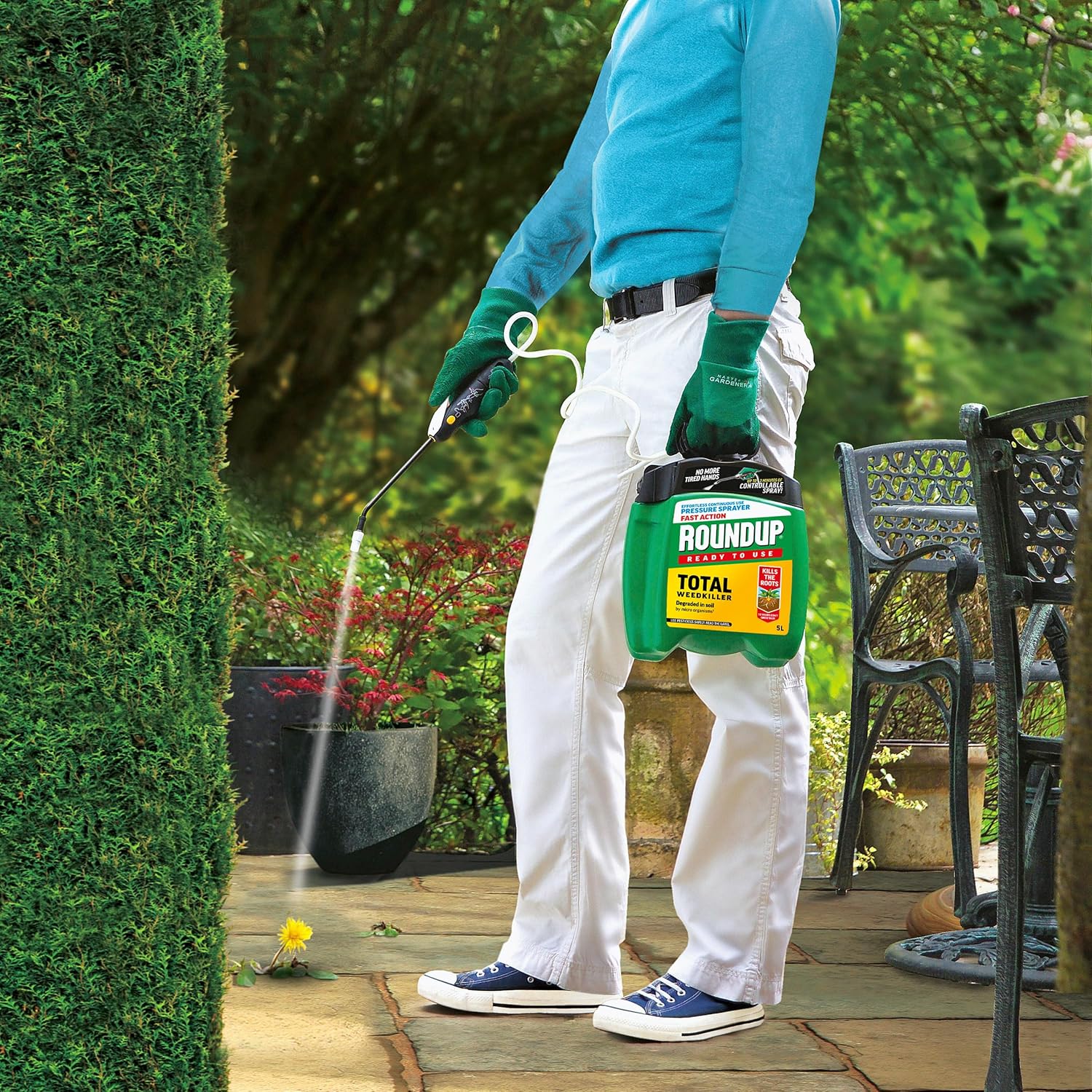
On common surface weeds - the stuff poking out of paving, gravel and block drives - most people see yellowing within hours and brown, visibly dying growth within 1-2 days. Mike describes it as: "Green becomes yellow in minutes, and is brown in just a few hours." Suzannah wrote that it "Worked amazing on our driveway." Mrs Maureen Bateman said it "killed a range weeds in gravel quickly and leaving a neat appearance."
It works on the harder stuff too, but slower and usually not in one pass. Gary reported that buddleia taking root around his drainpipe "withered and died in about ten days" after a couple of applications. D. Honeywill needed two applications on ivy, nettles and brambles on a hedge, and those weeds hadn't returned two years later. That's roughly how glyphosate behaves: great on annuals and surface growth first time, needs repeat visits on anything with deep roots, rhizomes or woody stems.
Rain is where it gets interesting. The label says you need a dry window after application for it to be absorbed, but Allanah Sparks got caught by a shower not long after spraying and posted day 3 and day 4 photos showing the weeds still dying. Don't bank on that though. If a downpour is coming, wait.
The Sprayer Problem Nobody Talks About on the Front of the Bottle
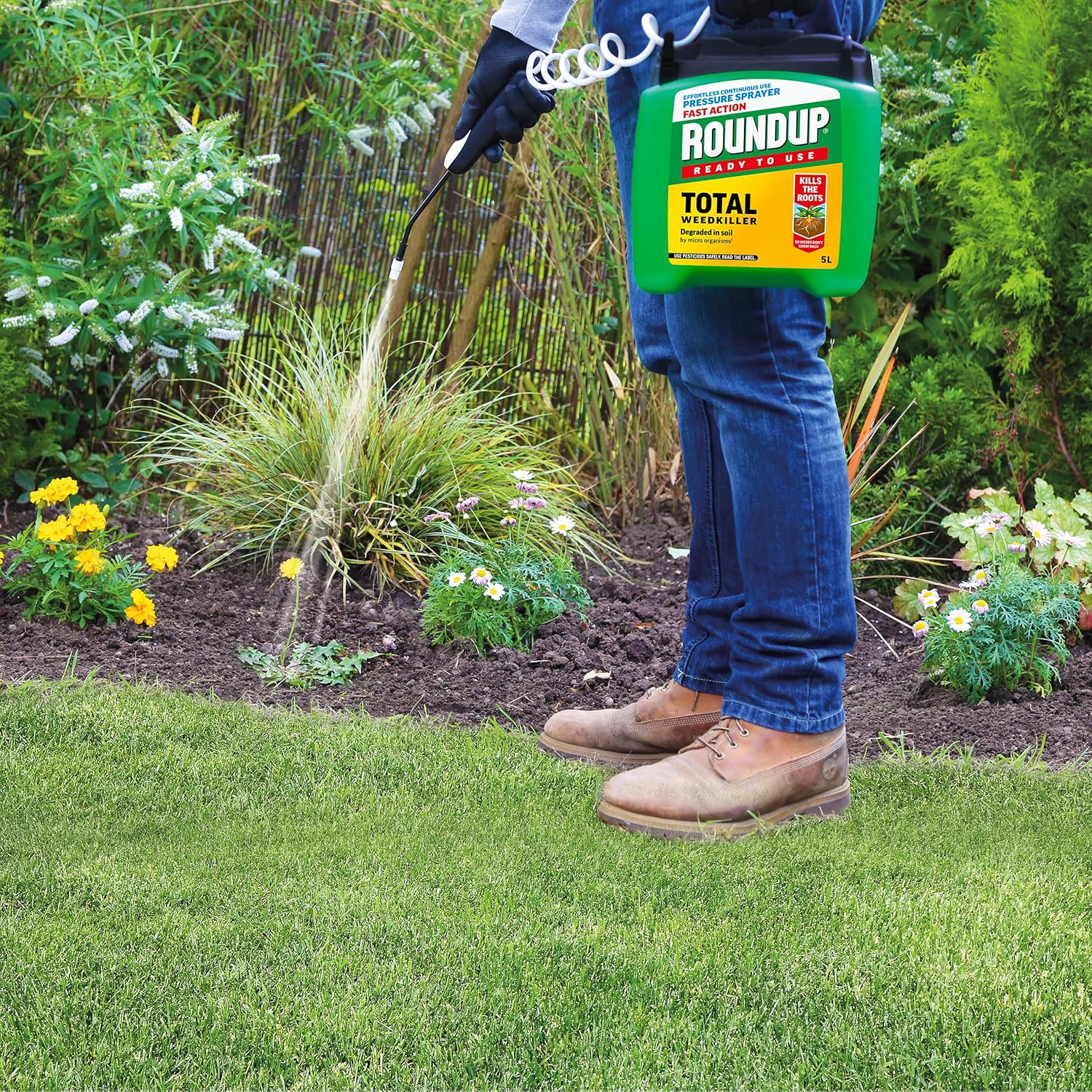
This is where the review breaks apart from the marketing. A meaningful chunk of 1 and 2-star reviews aren't about the formula at all. They're about the pump assembly. Born Blonde: "Contents great as royndup very good, but pump broke after one use and wouldn't squirt. I had to decant into another pump spray bottle." Peter Davies: "spray does not work. tried pumping it up but will not work." E C: "This sprayed at first and now it want spray anymore. You can't open it to put in to something else." Banno: "I have just received my Roundup, and the handle is broken." Reggie: arrived leaking, nozzle wouldn't spray, had to decant. Kay2: same story, sprayer wouldn't work, lucky to have a spare container.
The workaround most buyers end up using is the same: transfer the contents into a separate garden sprayer they already own. If you already have a reliable Hozelock or Spear & Jackson pressure sprayer in the shed, this failure mode is annoying but not catastrophic. If this Roundup bottle is meant to be your sprayer, and it arrives broken or stops working after one session, you're stuck.
The other build complaint is leakage. Rev. A. Kelso found liquid pooling under the bottle in the garage overnight, including at the top seal. Nicola B. just got "Item turned up damaged." Glyphosate leaking in a garage onto a shelf or a concrete floor is more than an inconvenience.
None of this is universal. Most people pump it up and it works. But it's common enough that if yours turns up damaged or fails, flag it to the seller immediately rather than assuming it's your fault.
Roundup Fast Action Weedkiller Pump 'N Go 5L
Ready-to-use glyphosate spray for patios, drives and borders. Visible results in 1-2 days, pressure sprayer with extendable lance, no mixing required.
"Refillable" Is Doing Some Heavy Lifting
The Amazon listing describes the sprayer as refillable with a one-touch trigger. In practice, most buyers find the bottle is sealed in a way that makes refilling awkward or impossible, and UK recyclers typically won't accept the empty container because of chemical residue. Robert Ibbeson was blunt: "I thought that I could reuse the sprayer (with more weed killer) when it was empty. But no, you can't. Plus, to cap it off, the recyclers won't take it either."
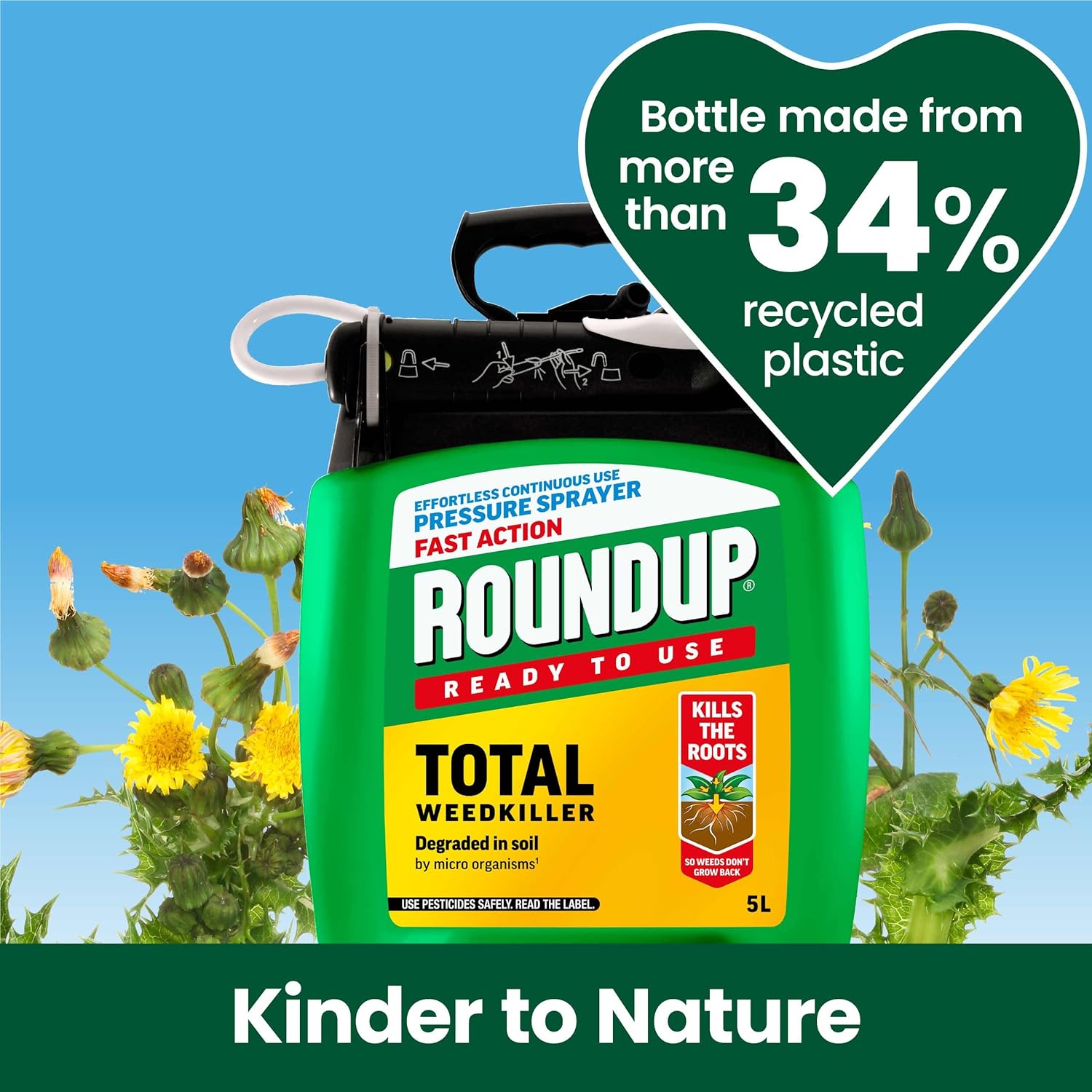
Roundup does note the bottle uses more than 34% recycled plastic and includes recycling guidance on the label. Empty bottles need to be triple-rinsed and disposed of according to local authority rules, which varies across UK councils. The reality is that for most people this is a single-use product with a sprayer attached, not a long-term refillable system. Worth knowing before you buy if reusability was a factor in your decision.
When Weeds Grow Back (And Why)
Glyphosate kills what it touches down to the root on contact, but it doesn't sterilise soil and it doesn't stop new seeds germinating later. That catches some buyers out. Andrew Lovegrove: "Short time solution does kill weeds but are back after 2 months." Itai Ankrah: "It kills weeds but they always grow back, its better to pull them out." JerryLeigh: "Weeds were back within a few weeks."
For driveways and patios, regrowth within a few weeks to a couple of months is normal with any glyphosate product. You're killing the plant that's there, not the soil's seed bank. For a rhizome-spreading weed like ground elder or couch grass, a single application usually isn't enough either. One reviewer with an unidentified flowering rhizome weed said it browned for a day, then "came back with a vengeance about a month later." That's the nature of those roots, not a Roundup problem specifically.
If you want genuine long-term suppression on a driveway or gravel area, pair this with a residual path weedkiller designed to stop regrowth, or plan two or three passes across a season. Treating it as a one-and-done solution sets you up for disappointment.
Is It Safe? Plain Facts on Glyphosate
Glyphosate is a regulated active ingredient. This specific product is approved for UK home and garden use under MAPP 14481 and PCS n° 01669. The label says children and pets can go on treated areas once the spray is dry. That's the regulatory position in the UK as of this review.
There is ongoing scientific debate about glyphosate. The World Health Organization's International Agency for Research on Cancer (IARC) classified it as "probably carcinogenic to humans" in 2015. The European Food Safety Authority, the UK's HSE and the US EPA have all reached different conclusions and re-authorised it for continued use, with the EU recently extending approval through 2033. One Amazon reviewer, Kes, flagged a 2000 glyphosate safety paper retraction and the IARC classification as reasons to be cautious. Those are real, published positions, and worth knowing.
Practically: wear gloves, avoid spraying in wind, keep the mist away from pets and plants you care about, and wash your hands afterwards. One reviewer mentioned feeling dizzy during application and suggested a mask if you're chemically sensitive. On a still day outdoors, most UK buyers spray without issue. If you'd rather avoid glyphosate entirely there are acetic acid and pelargonic acid alternatives, though they work differently (mostly surface contact, no root kill) and cost more per square metre.
Roundup Fast Action Weedkiller Pump 'N Go 5L
Ready-to-use glyphosate spray for patios, drives and borders. Visible results in 1-2 days, pressure sprayer with extendable lance, no mixing required.
Who Should Buy It, Who Shouldn't
Buy this if you have a patio, block-paved drive, gravel area or neglected corner with visible surface weeds, and you want a ready-to-use spray without the faff of measuring concentrate into a pressure sprayer. The ergonomics really do help anyone with back problems, arthritis or limited mobility, and the formula works quickly on annual weeds. At £29.99 for 5L it's competitive against buying a separate Roundup concentrate plus a sprayer, provided the sprayer works.
Think twice if: you already own a good garden pressure sprayer (buy a concentrate refill instead, you'll get more litres per pound), you're trying to clear a large lawn area or deep-rooted perennials in one pass, you want something reusable long-term, or you'd rather avoid glyphosate on principle. Also think twice if you're relying on this product alone being the sprayer. Having a backup container in the shed makes the whole purchase less stressful given the failure rate.
Overall: a strong weedkiller wrapped in a patchy piece of plastic hardware. Most buyers get a working bottle and are very happy. A meaningful minority don't, and if you're the latter, the formula inside is still usable if you've got somewhere to pour it.