
How to Stop Hot Tub Water Going Cloudy: UK Guide
Published 26 August 2026
Cloudy hot tub water usually traces back to the filter, the sanitiser, the chemistry or water that is simply worn out. Here is the order to fix them in, and the routine that keeps a UK tub clear into autumn.
We earn commission from qualifying Amazon purchases. It costs you nothing and does not affect what we recommend.
Quick Answer
First, stay out of it. Cloudy water means the sanitiser is not keeping up, so nobody should get in until it is tested, treated and visibly clear again. To stop hot tub water going cloudy, test the water two to three times a week and hold chlorine at 3 to 5 ppm (or bromine 4 to 6 ppm), pH at 7.2 to 7.8 and total alkalinity at 80 to 120 ppm, rinse the filter regularly and shock dose after heavy use. If the water has already turned, work in order: test and rebalance, deep clean the filter, shock dose, add clarifier, and drain and refill if it still will not clear.
- Test the Water and Balance pH and Alkalinity First
- Deep Clean the Filter Before You Shock or Clarify
- Shock Dose the Water to Break Down Contaminants
- Add a Clarifier So the Filter Can Catch Fine Particles
- Drain and Refill When the Water Is Past Its Best
- Build a Simple Routine That Stops Cloudiness Coming Back
- Frequently Asked Questions
- Related Reading
Lift the cover expecting an inviting sparkle and instead the water looks like weak milk. Cloudy water is one of the most common problems UK hot tub owners run into, and it usually traces back to four things: a filter that needs attention, sanitiser that has run out of fuel, water chemistry that has drifted, or water that is simply worn out. Before anything else: do not get in. Cloudiness is a sign the sanitiser is losing to what is in the water, so the tub is out of use until it is clear and back in range.
The haze itself is suspended particles - skin cells, body oils, sun cream, cosmetics, detergent residue and garden debris - most of them too small for the filter to catch unaided. This guide works through the fix in order, from testing to draining, then the routine that keeps a British tub clear as autumn arrives.
Test the Water and Balance pH and Alkalinity First
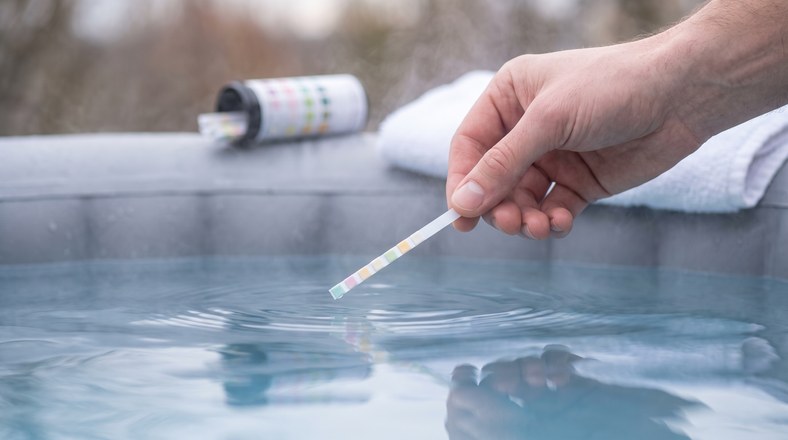
Cloudy water is a symptom, and the test kit tells you which problem you are treating, so before adding anything take readings for sanitiser, pH and total alkalinity and write them down. Follow the timing on your own pot, because packs differ: Clearwater's strips say dip and remove immediately then hold the strip level for 15 seconds before reading, and EASYTEST says one second in the water and 15 seconds held flat. Do not shake the excess off, and read at the stated time rather than early or late, because the pads keep developing and a misread strip means the wrong chemical goes in.
UK suppliers broadly agree on the target ranges, with small differences:
- Free chlorine: 3 to 5 ppm, or total bromine 4 to 6 ppm
- pH: 7.2 to 7.8, with some suppliers preferring a tighter 7.4 to 7.6
- Total alkalinity: 80 to 120 ppm, though some quote up to 150 ppm
- Calcium hardness: 150 to 250 ppm, which matters most in England's hard-water areas, where high calcium shows up as scale at the waterline and a haze that will not shock out
Alkalinity is the buffer that holds pH steady: if it is out of range, pH wanders after every adjustment, so correct alkalinity first, circulate, retest, then nudge pH. And pH matters twice over, because a high reading encourages haze and scale while quietly disabling your sanitiser - industry guidance puts chlorine as much as 80 per cent less effective above pH 7.8, one way a tub with a fine-looking chlorine reading still turns milky.
Strips suit the quick, frequent checks that catch drift early, and both packs we have reviewed read several levels in one dip. Our Clearwater test strips review splits between devoted regulars and buyers whose strips read zero chlorine in freshly dosed water, and the use-by date links the two camps: 19 of the 100 most recent reviews describe dates on the pot base rubbed off, missing or already passed. Check the date the day a pot arrives and return any you cannot read. And because that review documents two strips from one pot reading differently, cross-check a surprising result against a different pack, not a second strip from the same tube - our EASYTEST strips review weighs up whether the lesser-known pack can out-read the big names. If the water refuses to respond, take a sample to a pool and spa shop for a fuller set of tests before adding more chemicals.
One caveat on order: take your readings now, but if the filter is visibly loaded, clean it before you dose anything beyond a sanitiser top-up. Balancers added to water that is about to spend eight hours without a filter are wasted, and you will only have to retest afterwards.
Deep Clean the Filter Before You Shock or Clarify
Ask the UK retailers and no two rank the causes of cloudy water the same way, but every list includes a dirty filter, and it is the cheapest suspect to rule out first. One giveaway: water that sits clear until the jets start, then turns milky within minutes, means the cartridge has stopped holding what the pump pushes through it - and every treatment poured into that loop is wasted.
Be realistic about what filtration can achieve, though. Most cartridges only trap particles down to about 5 to 10 microns, and the very finest haze-forming particles pass straight through, which is why the filter and the chemistry have to work as a team. That is not a reason to leave a blocked one in. A loaded cartridge restricts flow, strains the pump motor, pushes up running costs and on many hard-shell tubs will trip a flow or heater fault (LF, HL, Dr or Dy on the panel). Lay-Z-Spa is blunter still: a clogged filter constricts flow and puts extra strain on the pump.
Switch the power off at the tub before you take the cartridge out, so debris is not pulled down the empty filter fitting. Then work through the routine:
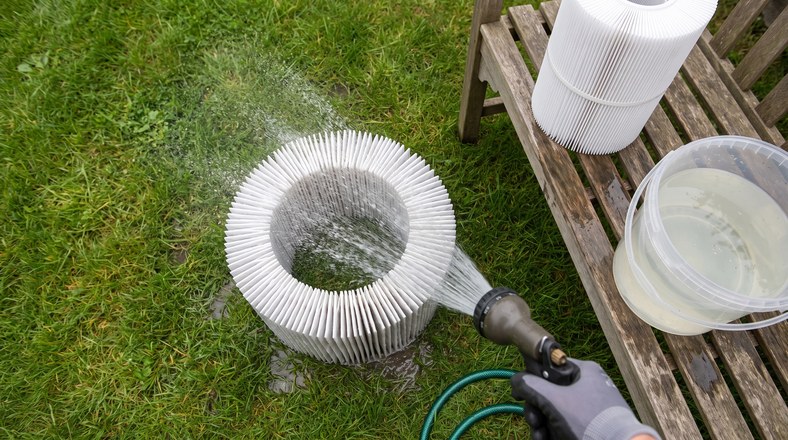
- Rinse it often. Lay-Z-Spa's advice for its own cartridges is a rinse between uses, or every other day at minimum; other suppliers suggest around once a week. Aim the hose into the gaps between the pleats, where the debris packs in.
- Give it a chemical clean on a schedule. A hose only moves the loose stuff, while body oils and biofilm work deep into the pleats and stay put. Soak the cartridge in filter cleaner solution overnight, or for at least 8 hours, then rinse thoroughly - suppliers put this deep clean anywhere from fortnightly to monthly depending on use. Leave the washing-up liquid in the kitchen: household products deposit a residue that comes back as foam. And check what your cartridge is first: plain pleated paper soaks fine, but mineral or antimicrobial cartridges (Master Spas EcoPur and similar) must only be rinsed, because a chemical soak strips the minerals out of them.
- Plan around the soak. If you only have one cartridge, either buy a spare before you start or use a spray-on filter cleaner (spray, leave 15 minutes, rinse) so the tub is only unfiltered for minutes rather than overnight. Do not run the tub with the housing empty while the cartridge soaks.
- Let it dry before it goes back. Drying firms the filter fabric back up, so a dried cartridge filters better than one refitted wet; a spare on rotation lets one dry while the other works.
- Know when cleaning is finished. A torn pleat, pleats slumped flat, brittle fabric or discolouration that no wash shifts all mean the cartridge is spent - replace it. Lifespan advice varies enormously: inflatable tub cartridges are swapped every few weeks, while hard-shell cartridges are variously quoted at 6 to 12 months, 12 to 24 months, or 2 to 3 years with careful upkeep.
Shock Dose the Water to Break Down Contaminants
With the chemistry balanced and the filter clean, a shock dose deals with what is actually clouding the water: dissolved organic waste. Shocking oxidises body oils, sweat and cosmetic residue, kills bacteria grown resistant to the everyday sanitiser, and breaks down chloramines, the spent compounds formed when sanitiser reacts with bather waste. Chloramines explain the harsh chlorine smell mistaken for too much chlorine, and the dull water that defies a reassuring strip reading.
There are two types of shock, suited to different jobs:
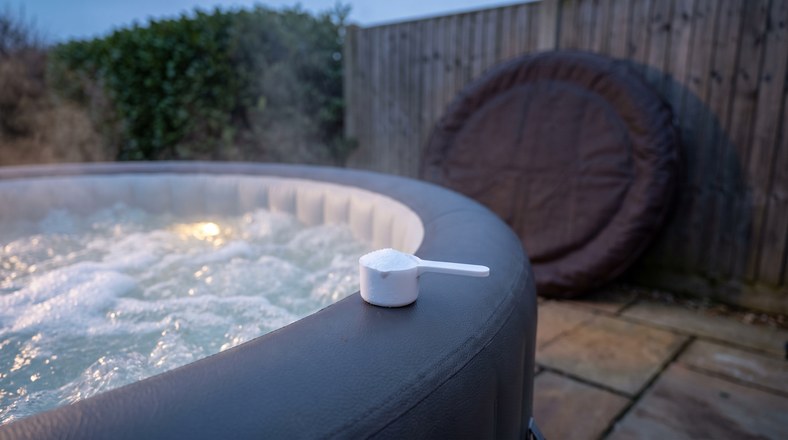
- Chlorine shock hits hardest and is the right choice for properly murky water in a chlorine tub. Dose chlorine granules at 20 g per 1,000 litres (Lay-Z-Spa's worked example is 16 g, about 3 teaspoons, for its Miami AirJet, which implies a filled volume of about 800 litres), then stay out of the water. Wait at least 24 hours, retest, and only bathe once free chlorine has settled back to 3 to 5 ppm with pH and alkalinity in range. If you run bromine, shock with bromine granules instead and wait for total bromine to fall back to 4 to 6 ppm before anyone gets in. Check your strips read bromine before you rely on them: the Clearwater 3-in-1 pack has no bromine pad, the EASYTEST pack does.
- Non-chlorine shock (MPS) oxidises contaminants without raising the chlorine level. The usual UK dose is 20 g per 1,000 litres, circulated with the cover off for up to an hour. Use your own tub's filled volume, not an average: hard-shell tubs are commonly around 1,500 litres and an inflatable holds considerably less, and the filled figure is printed in the manual or on the box, a step below the advertised capacity. Because it does not spike the sanitiser, the tub is usable far sooner, which is why many owners make it the routine weekly oxidiser.
With a chlorine shock, the dose is a starting point rather than a rule, because granule strengths differ. What you are aiming for is a free chlorine level of roughly 10 to 20 ppm straight after dosing, so test once the water has circulated for half an hour and top up if it has not got there.
Some rules apply to both: treat with the cover off and the pump running, so the dose circulates and fumes vent. Wear gloves and eye protection, never mix products together, and always add chemicals to water, never water to chemicals. Keep children and pets away while you are dosing, and remember an uncovered tub is an open tub: if you are leaving the cover off for 24 hours after a chlorine shock, make sure nobody can get to it unsupervised. Then let the system strain out what the shock broke up: run 8 to 24 hours of filtration, extending the cycle for a day or two or, on an inflatable with no programmable panel, simply leaving the filter pump running. Improvement is rarely instant - the dead, oxidised particles still need catching, which is the next step's job.
Add a Clarifier So the Filter Can Catch Fine Particles
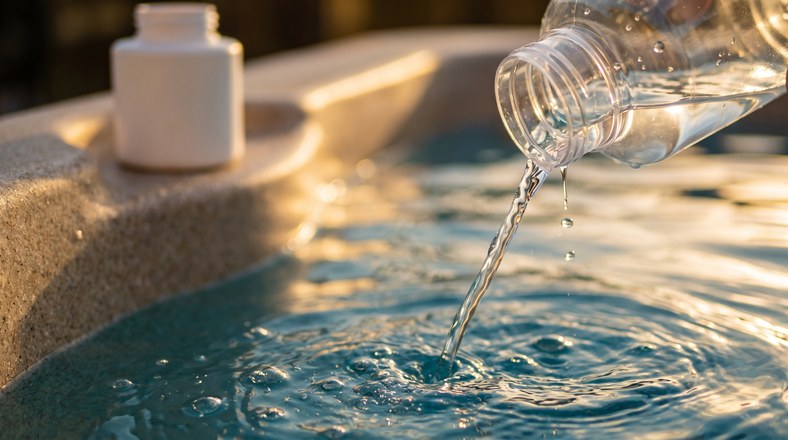
If the water has improved from milky to a faint, stubborn haze, the remaining particles are simply too fine for the cartridge to catch. This is the one job a clarifier does well: it is a coagulant, bonding microscopic particles into clumps large enough for the filter to trap, and the haze then leaves through ordinary circulation.
Used at the right moment it is the finishing polish; used as a shortcut it disappoints, and that split is exactly what buyer feedback in our Clearwater Water Clarifier review shows: the same bottle clears one tub and fails another. The reviews that report failure usually describe one of four things: balanced chemistry skipped, the dose measured for the wrong water volume, no working filter to catch the clumps, or judging it after twenty minutes instead of twenty-four hours. It polishes; it does not sanitise, and it cannot rescue water that is past its best.
Three rules get the best from it:
- Dose after the shock, not instead of it. Clarifier is there to gather up dead, oxidised debris, not to clump living contamination in unsanitised water.
- Follow the label and resist topping up. Give it a full 24 hours with the pump running before you judge it. The most common way owners overdose a clarifier is checking after twenty minutes, seeing no change and pouring in more - and overdosing is itself a recognised cause of cloudy water, gumming up the filter.
- Rinse the filter afterwards. Everything the clarifier gathers ends up in the cartridge, so hose it through once the water clears to restore full flow.
Judge progress by depth of vision - when you can see the bottom of the tub crisply, clarity is back - and finish with a strip test to confirm the water is balanced before anyone climbs in.
Drain and Refill When the Water Is Past Its Best
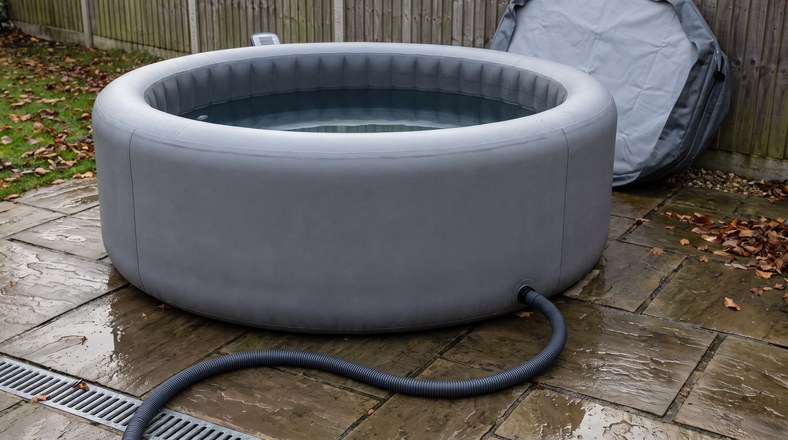
Sometimes nothing works because the water itself is finished. Every product dose, top-up and bather adds to the water's total dissolved solids (TDS), and once TDS climbs high enough the water is saturated: fresh chlorine dissolves slower and slower, levels refuse to hold, and cloudiness returns within days of each treatment. Stabilised or multifunction tablets add a second version of the same problem: every tablet adds cyanuric acid, which eventually blocks the chlorine from being useful, and nothing lowers it except removing some or all of the water. Either way, the water needs replacing, not rescuing.
How often? Sources differ, and usage decides it. Lay-Z-Spa recommends fresh water every 1 to 3 months; several UK suppliers say every 3 to 4 months; and one retailer's rule of thumb when fighting cloudiness is to drain once the fill is more than 8 weeks old. For a personal figure, divide the tub's volume in litres by 10, then by the number of daily bathers, to get days between changes - a 1,200 litre tub with 2 daily users works out at 60 days. If you own a TDS meter, a reading above 1,500 ppm means start again. With autumn beginning, a summer-worked tub is a prime candidate for a reset. One caution on timing: refill a hard-shell tub the same day you drain it. Pipework and pumps left standing empty through a frost can split, so if a cold snap is forecast, either do the change on a mild day or winterise the tub properly instead of leaving it part-drained.
Do the change properly, or the cloudiness comes straight back:
- Flush the pipework first. Biofilm and oily residue hide in the plumbing and re-contaminate a fresh fill - the classic sign is water clouding again days after a refill. Circulate a pipe flush product before draining; a typical label has you run the jets for 30 minutes, then let the water sit for 30 minutes.
- Drain and clean everything. Empty through the drain valve, or faster with a submersible pump, then clean the liner, jets, filter housing and the underside of the cover with a spa-safe cleaner and rinse well. Think about where the water goes. Sanitised spa water should not be run straight onto planting, a lawn or a drain that reaches a watercourse. Stop dosing a day or two before you drain, let the sanitiser fall away, then check with a strip before you send it anywhere near a border. Otherwise, send it to a foul drain.
- Refill and balance from scratch. A pre-filter on the garden hose reduces what arrives with the fill. Test before adding sanitiser: correct alkalinity, then pH, then establish the sanitiser level, and retest after the first heat-up cycle. Fresh mains water can carry minerals and metals that react with treatments, so dose gradually.
One extra for new owners: manufacturing residue means a brand-new tub is often best drained within its first month, with a flushing agent, before settling into a normal schedule.
Finally, know when it is not chemistry at all. Cloudiness arriving with an error code, weak jets, odd noises, a persistent smell, recurring foam or water that will not hold a sanitiser level points at the machinery: poor circulation, a low water level, an airlock or a closed diverter will keep water dull whatever you dose. Stop buying treatments and call a qualified hot tub technician.
Build a Simple Routine That Stops Cloudiness Coming Back
Once the water is clear, keeping it that way is mostly about what you keep out of it, and small habits carry most of the load:
- Shower before you soak. A plain rinse, no soap needed, removes the moisturiser, deodorant, fake tan and skin oils that would otherwise wash off in the tub.
- Rinse swimwear in warm water, never detergent. Laundry residue is a prime source of foam and haze.
- Wipe the waterline. Body oils and sun cream collect there as a greasy tide mark and work their way back into the water; a quick wipe when you rinse the filter keeps them out.
- Float an oil absorber. An oil-absorbing sponge or even a plain tennis ball left on the surface picks up body oils and sun cream before the sanitiser has to deal with them - a help rather than a complete fix, but the one physical tool for the job.
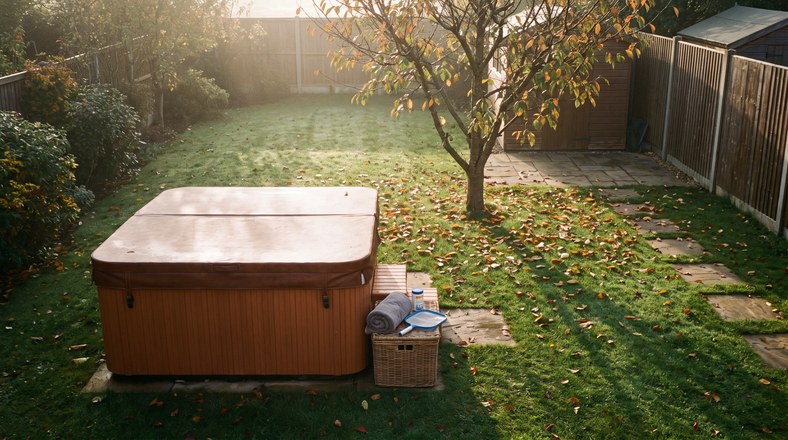
- Keep the cover on between uses. Falling autumn leaves, wind-blown debris and rain all land in an open tub, especially near trees and hedging; a skimmer net catches what sneaks past, and a footbath stops grass and grit walking in with you.
Then hold the line on chemistry: test the water two to three times a week, and again after any busy session, topping up sanitiser as needed. Chlorine granules give fast, controllable dosing and are pH neutral, which is why several UK suppliers recommend them over tablets. Slow-dissolving tablets in a floating dispenser hold a steadier level between checks and suit owners who cannot tend the tub daily, with two caveats: they are acidic and can damage the tub if misused, so watch the pH, and multifunction tablets also add stabiliser. In a small volume of water, stabiliser accumulates until it blocks the chlorine from working, which shows up as water that clouds even though the strip reads a fine chlorine level. If that is happening, a drain and refill is the only way to reset it. Buyers in our Clearwater multifunction chlorine tablets review consistently call the dispenser routine the low-effort way to hold a steady level between dip tests. On top of the daily sanitiser, Happy Hot Tubs recommends a weekly non-chlorine shock, plus an extra shock after heavy use, to burn off contaminants before they build up.
Finally, watch for the green early-warning. True algae turns water green rather than white, but the problems meet in the middle: dead algae clouds water, and a greenish haze usually means sanitiser has dipped and a bloom is starting. The cure is the same testing and shock routine. If your tub sits under trees or keeps drifting towards green, a preventive algaecide is worth keeping to hand, but only if you are not already running a multifunction tablet, which contains one: doubling up wastes product and adds to the residue the filter has to catch. Our Clearwater Algaecide review found it works as a weekly preventer rather than a rescue, slow and unreliable once water has already turned, and it does nothing for ordinary white cloudiness.
Frequently Asked Questions
Is it safe to use a hot tub while the water is cloudy?
No. Cloudiness is a warning that the sanitiser is not coping, which means bacteria may be thriving. Stay out until you have tested and treated the water and it is visibly clear again, with your sanitiser back in range (free chlorine 3 to 5 ppm, or total bromine 4 to 6 ppm) and pH and alkalinity balanced.
Why is my hot tub still cloudy after shocking it?
Three usual suspects. The pH may be too high for the shock to work properly, since chlorine loses much of its power above pH 7.8. The filter may still be loaded and re-circulating particles. Or the water may be old and saturated with dissolved solids, which only a drain and refill fixes. A fourth, if you use multifunction or stabilised tablets: stabiliser builds up in a small tub and eventually stops chlorine working even at a normal reading, and only a fresh fill clears it. Check chemistry, the filter and water age in that order before reaching for a second dose.
How long does cloudy hot tub water take to clear?
Fix the actual cause and cloudiness often clears inside a day: clean filter, balanced chemistry, shock, then clarifier, backed by 8 to 24 hours of filtration. That assumes you already have a clean spare cartridge to hand - if you are soaking your only filter overnight and then waiting out a chlorine shock, budget two days. One UK retailer's rule of thumb is 2 to 3 days for the water to come fully right, and a drain and refill takes longer again.
Why has the water gone cloudy again straight after a refill?
Usually one of two things. Biofilm and residue inside the pipework can survive a drain and seed the fresh fill, which is why flushing the pipes before draining matters. Fresh mains water can also carry minerals and metals that react as treatment products go in, so balance a new fill step by step: alkalinity, then pH, then sanitiser, with a retest after the first heat-up cycle.
Related Reading
Disclaimer: This article contains Amazon affiliate links. We may earn a small commission from qualifying purchases at no extra cost to you.